
RUNC: Evan Calabria
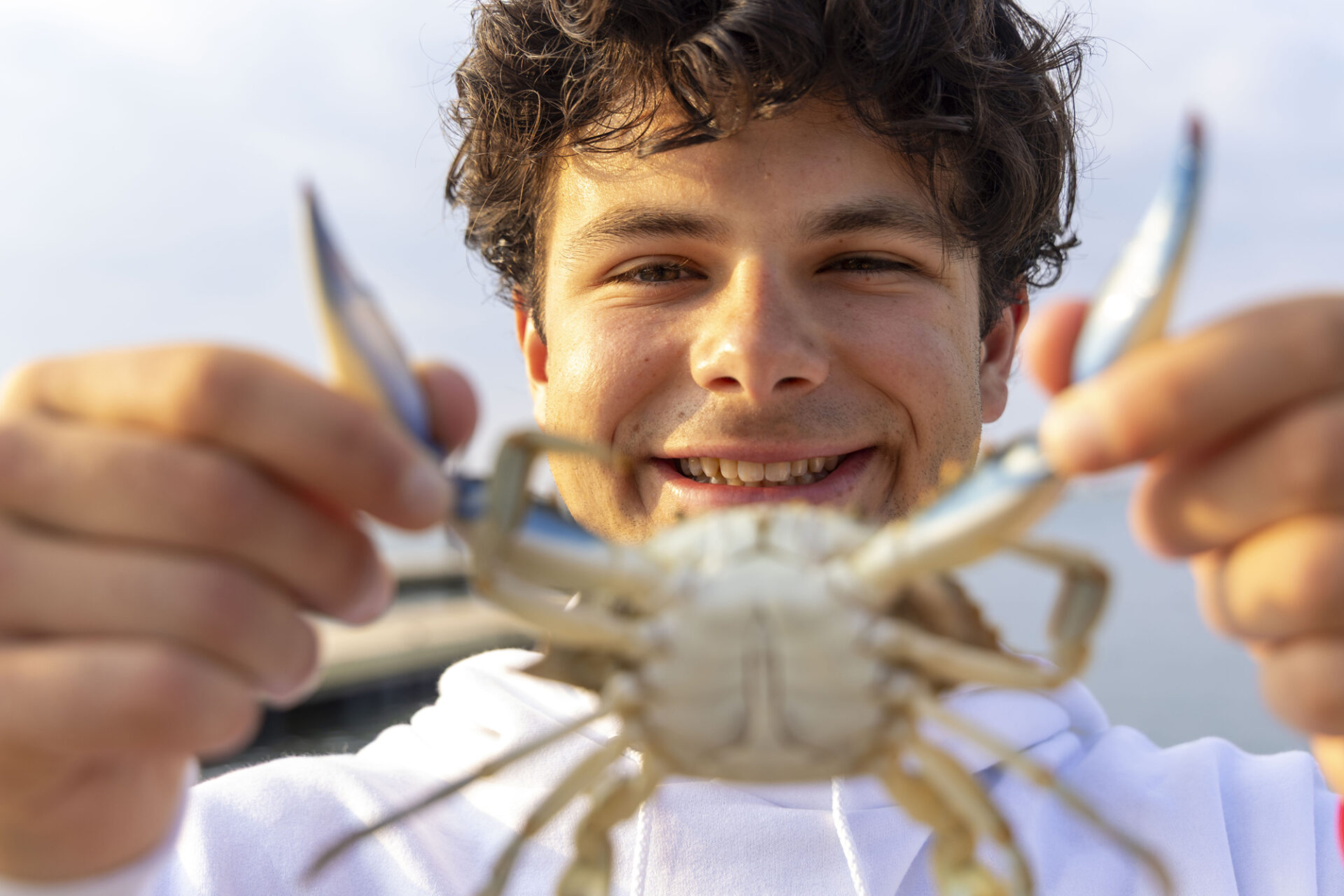
Evan Calabria explores how blue crabs could impact North Carolina’s coastal meadows.
By UNC Research
October 8, 2025
Impact Report

Evan Calabria conducts research at the UNC Institute of Marine Sciences, which offers immersive research experiences along the N.C. coast and has trained 500+ Carolina students.

N.C. is home to 100,000 acres of seagrass and has lost about 6,000 acres over the past two decades, according to the N.C. Department of Environmental Quality. Just 100 acres can support 80,000 fish and 100 million small invertebrates.
Evan Calabria is a junior in the Department of Earth, Marine, and Environmental Sciences within the UNC College of Arts and Sciences and a Summer Undergraduate Research Fellow (SURF).
He investigates whether marine invertebrates — such as blue crabs, sea urchins, and spider crabs — feed on the seeds of eelgrass, an underwater plant that nourishes coastal ecosystems by providing food, shelter, and oxygen. If they do, he aims to understand how this interaction could influence the distribution and resilience of these vital meadows across North Carolina.
How did you discover your specific field of study?
I’ve learned to admire and appreciate marine ecosystems along the Outer Banks from growing up fishing every summer with my family in Harkers Island, N.C. From fishing to volunteer work, I’ve always wanted my efforts to center around conserving these beautiful waters. Now, having studied in the Galápagos Islands, worked with the Institute of Marine Sciences, and finalized my SURF grant research, I am excited to continue working to preserve our oceans.
Academics are problem-solvers. Describe a research challenge you’ve faced and how you overcame it.
My research initially focused on whether adult blue crabs eat eelgrass vegetative shoots containing seeds and if those seeds remain viable after consumption. Within a week of trial runs, it became clear that adult blue crabs did not want the seeds. I discussed the plan with my mentor, PhD student Heather Bruck, and wondered if crab size played a role, as smaller claws might be better suited for picking up seeds. This led to my next question: Do juvenile blue crabs and other marine invertebrates consume eelgrass seeds? I found that smaller blue crabs and urchins ate the seeds more often than the larger crabs. The day I noticed seeds missing from the tank where we monitor them was an exciting one!
Describe your research in five words.
Tiny crabs, big ecosystem drama.
Who or what inspires you? Why?
My parents are my biggest motivators because of their strong work ethic and the love they have for what they do. They inspire me to be passionate about my studies and to dare the impossible. I always aim to make them proud.
If you could pursue any other career, what would it be and why?
I would pursue a career in environmental public health to help people access health care and address environmental pollution. I chose marine science because it allows me to support both communities and the environment, creating a healthier and more sustainable future.
Research UNCovered delves into the lives of Carolina researchers from all disciplines and career levels, showcasing not only their research prowess but personal experiences in academia and beyond. Read more RUNC features here.