
RUNC: Clara DiVincenzo
The undergraduate researcher studies how climate impacts coral reefs.
By UNC Research
February 11, 2026
Natural Sciences · Research Uncovered
Impact Report

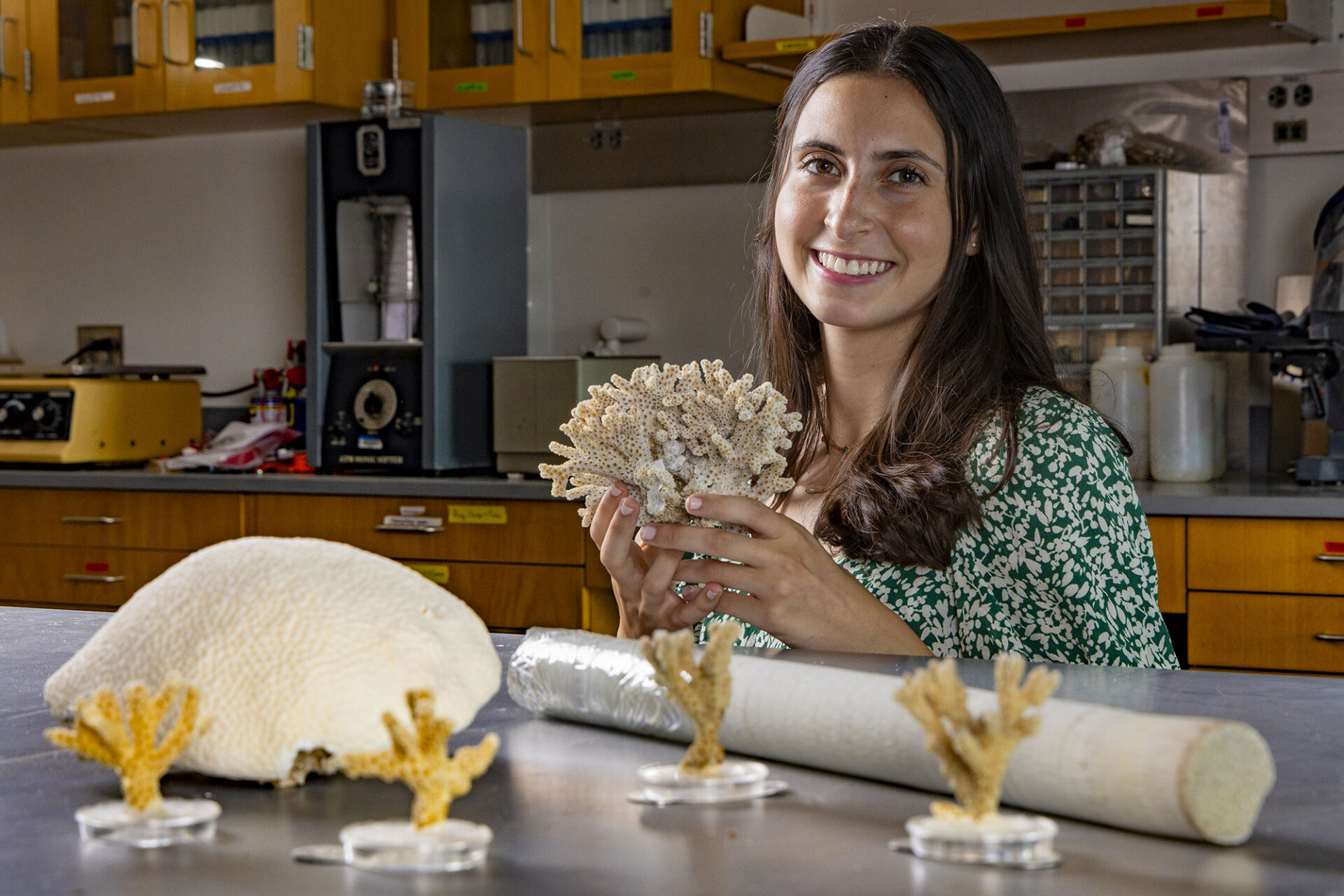
Clara DiVincenzo works in the Castillo Lab at UNC-Chapel Hill, where researchers study how environmental stressors impact coral reefs — ecosystems that support 1 billion people worldwide.

Coral reefs contribute $3.8 billion to the U.S. economy, supporting fisheries, tourism, and coastal protection, according to the U.S. Office for Coastal Management.
Clara DiVincenzo is a senior double-majoring in biology and statistics within the UNC College of Arts and Sciences. She studies the relationship between climate and coral reef health. By examining how ocean temperatures affect corals and their symbiotic algal partners, she hopes to understand global reef decline to inform strategies for preserving these vital habitats.
How did you discover your specific field of study?
When I was little, I loved playing around with my dad’s computer on Microsoft Excel, making fake data and graphs. So, I’ve always been interested in the more technical side of scientific research.
I came into coral biology after doing an internship in coral reef restoration. I felt excited about working in marine conservation, but wanted to generate knowledge rather than apply it, which led me toward academic research at UNC-Chapel Hill. I was immediately interested in the Castillo Lab for the opportunity to combine real-world problem solving with quantitative analysis.
Academics are problem-solvers. Describe a research challenge you’ve faced and how you overcame it.
A key tenet of environmental research is fieldwork, and a key tenet of fieldwork is that nothing goes exactly as planned. I saw this first-hand while SCUBA diving off the coast of Morehead City, N.C., to set up a large coral transplant experiment. Diving at this site was difficult because of the strong tides that threatened to pull us into the open ocean. We could only dive during a single one-hour window each day, barely enough time to set up an experiment.
At one point mid-dive, we were assembling coral platforms using underwater screws and bolts when we realized we had forgotten screwdrivers — the most important tools for our task. Already underwater, we didn’t have time to breach the surface and head back to the lab since we’d miss our narrow dive window. Instead, we had to improvise. I looked around for anything nearby that might serve as a makeshift screwdriver: pieces of dive gear, parts of the seafloor, and finally, two flat, sturdy scalloped seashells. I signaled the seashell-as-a-screwdriver idea to my dive buddy with hand gestures, and together we managed to finish assembling the platforms with our improvised tools.
Thanks to quick thinking, we completed the experiment without getting swept out to sea. More importantly, the experience reinforced a lesson I now carry into every project: Successful research depends as much on creativity and adaptability as it does on planning.
Describe your research in five words.
Corals aren’t doing too hot.
Who or what inspires you? Why?
My family, friends, and colleagues. Every day, I get to watch them approach life with compassion, tackle their biggest goals, and be absolute superstars.
If you’d asked me this while I was a kid, I would have said Whitney Houston for her total vocal dominance, deep generosity, and resilience and Cirie Fields from the TV show “Survivor” for her kindness, intelligence, and unwavering determination.
If you could pursue any other career, what would it be and why?
A chef or music producer. I get most excited about creating things that make others happy, whether that be food, music, or a scientific outcome that could better someone’s life.
Research UNCovered delves into the lives of Carolina researchers from all disciplines and career levels, showcasing not only their research prowess but personal experiences in academia and beyond. Read more RUNC features here.