
RUNC: Alan Bi
The PhD student uses financial data to study the 2008 U.S. stock market crash.
By UNC Research
May 13, 2026
Impact Report

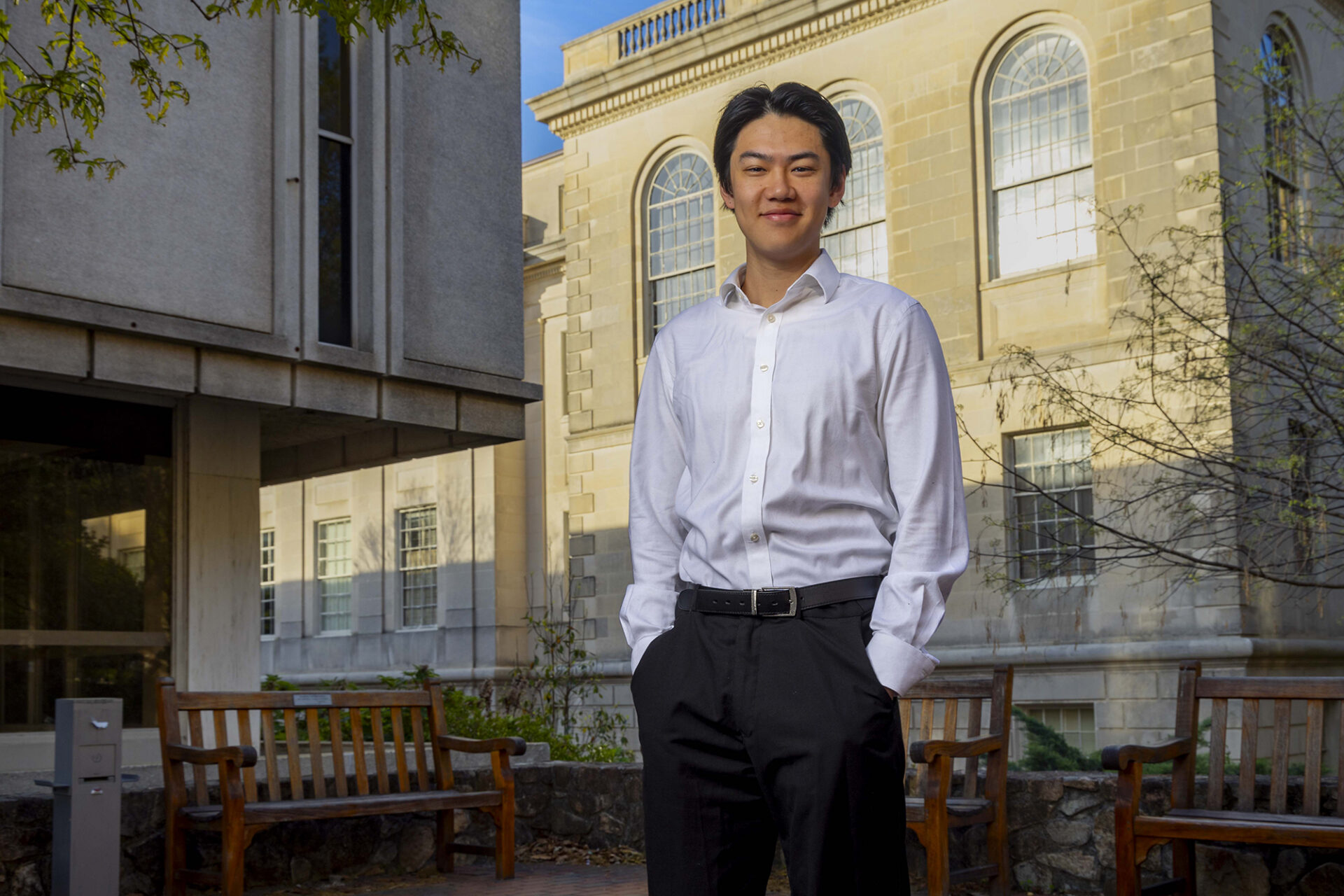
Alan Bi studies the causes and consequences of the 2008 U.S. financial crisis, generating insights that could strengthen today’s financial systems and help prevent similar collapses in the future.

The 2008 financial crisis led to the loss of roughly 9 million jobs, the stock market falling by 50%, and a drop in the value of U.S. goods and services, according to the Federal Reserve Bank of St. Louis.
Alan Bi is a PhD student in the Department of History within the UNC College of Arts and Sciences. He examines how the language from financial institutions influenced how investors conceptualized risk leading up to the 2008 financial crisis in the U.S.
How did you discover your specific field of study?
For my bachelor’s degree, I double-majored in accounting and history at Furman University. I’ve always been fascinated with Buffet-style investing — buying durable businesses that will succeed in the long-term versus making short-term predictions that are usually volatile. Accounting provides the tools to analyze annual reports and determine the true financial health and value of publicly traded companies. I also wanted to diversify my skills for the job market, and it’s far easier to find employment with accounting than with history.
After graduating in 2025, I decided I wanted to try to merge my two interests, studying the history of financial disasters by relying on my experience in forensic accounting.
Academics are problem-solvers. Describe a research challenge you’ve faced and how you overcame it.
The lack of literature on the 2008 financial crisis. I normally face a lot of skepticism when I refer to the 2008 financial crisis as “history” — it only happened 18 years ago, and it sometimes makes people mildly uncomfortable to see events they’ve lived through placed in a historical context. But whether something occurred 18 or 1,800 years ago, the true role of the historian is to analyze what happened, why it happened, how it connects to other historical ideas, and to shape how that historical reality is written in a way that is nuanced and factually accurate.
Right now, I just have access to annual reports, interviews, and transcripts from CEOs. I will have to break a lot of new ground. Given the lack of literature on such a defining moment of the 21st century, I believe that thinking about the 2008 financial crisis in these terms is critical for society to understand what truly happened during the crash in a politically unbiased way. I hope that the research I produce can be used by people within the financial world to contextualize their understanding of financial risk through history.
Describe your research in five words.
True history is about people.
Who or what inspires you? Why?
My grandfather and my dad are my biggest inspirations. My grandfather gave everything to send my dad to be educated in the United States when he himself never received anything more than an elementary school education, and I can never thank my dad enough for enduring the hardships he faced so that I could have a better life here. I’m publishing a biography that will be released later this year about both of their journeys from China to the U.S.
If you could pursue any other career, what would it be and why?
A jazz pianist. While history and finance are my biggest passions, Frank Sinatra and the Rat Pack are another.
Research UNCovered delves into the lives of Carolina researchers from all disciplines and career levels, showcasing not only their research prowess but personal experiences in academia and beyond. Read more RUNC features here.