
Restoring Rhythm
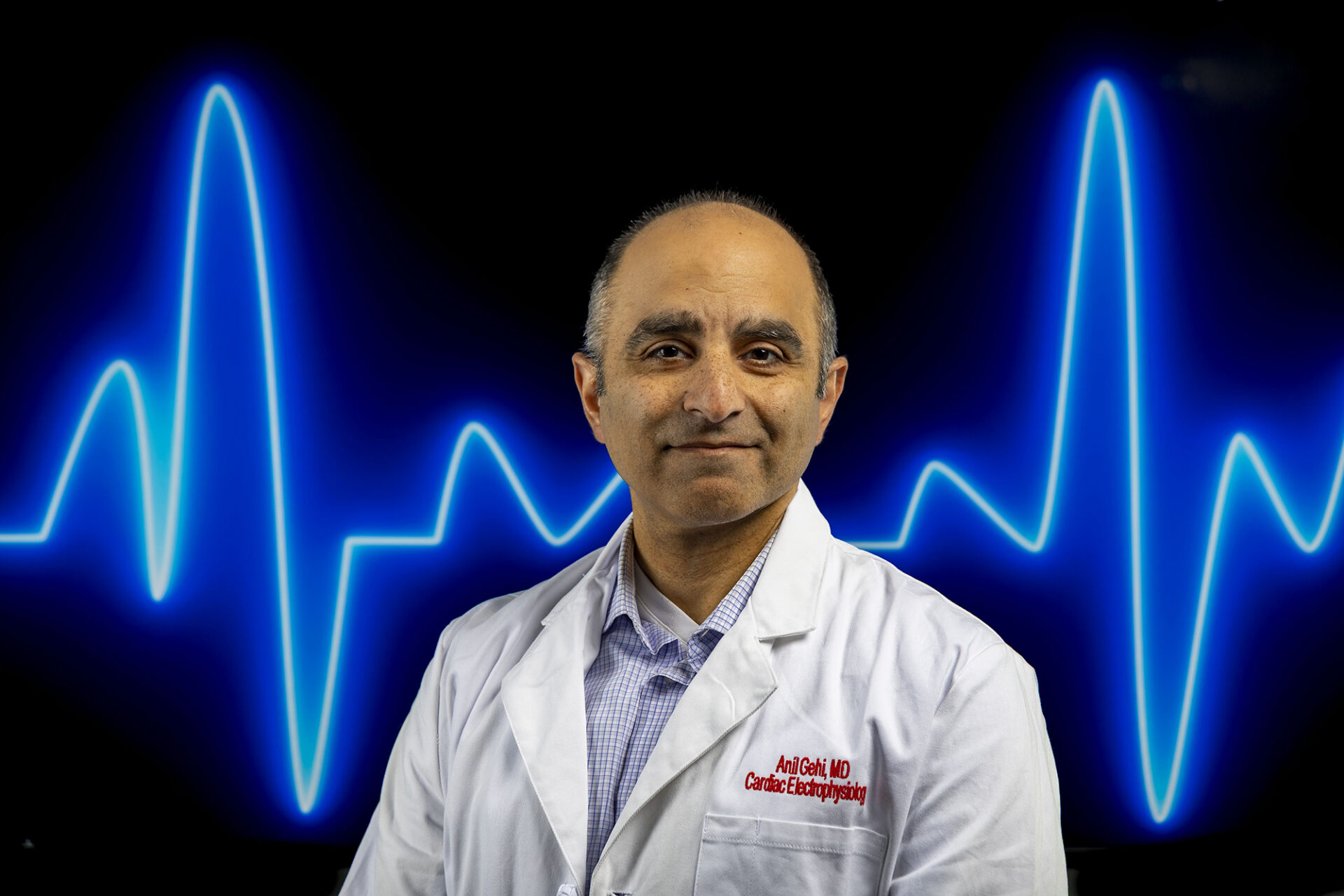
Drawing on his expertise in engineering and medicine, Anil Gehi is redesigning how hospitals, clinics, and patients manage heart rhythm disorders.
February 24, 2026
Impact Report

Anil Gehi is changing the way people with atrial fibrillation (AFib) are assessed and treated at UNC Hospitals, creating better systems of care for both doctors and patients.

AFib is the most common heart rhythm disorder, affecting nearly 50 million people worldwide, according to the American Heart Association.
Growing up, Anil Gehi tried to steer clear of becoming a doctor, reluctant to follow in his parents’ footsteps. Instead, as an undergraduate student at MIT in the early 1990s, he chose to study electrical engineering.
“I always had a predilection for science and math. So, I felt that engineering just made sense,” he says.
At first, it did.
“But as I got more and more involved with my courses, I started thinking about what a career in engineering might look like, and I felt it might not be as fulfilling as I’d hoped,” he admits.
Gradually, Gehi found himself more drawn to physiology and the intricate mechanics of the human body than to the circuits behind engines. Still, he resisted the pull toward medicine until his senior year, when curiosity tipped the scales.
In 1996, he enrolled in medical school at the University of California San Francisco, where he chose to specialize in cardiac electrophysiology — trading machine circuits for the electrical pathways that keep the heart beating.
“It put everything together,” he recalls. “Cardiac electrophysiology integrates cool technology, a problem-solving mentality, and the fulfillment of doing something for patients that’s curative.”
This blend of engineering and medicine shaped Gehi’s approach to care, looking beyond isolated symptoms to understand how interconnected processes affect outcomes.
“I’m not somebody who likes to memorize a bunch of facts. I like to figure it out,” he explains. “I was drawn to fields where you have to puzzle things together to identify the problem and its solution.”
As a cardiac electrophysiologist at UNC-Chapel Hill, he studies the heart’s electrical signals that orchestrate rhythm to sustain life.
A systems mindset
Gehi is a systems thinker. He approaches problems with an eagerness to understand the whole picture and a curiosity about the interactions between its different parts.
The heart, which is the primary system under his scrutiny, is elegant and precisely tuned. It captured human imagination long before science developed tools to understand its anatomy. In some cultures, it was revered as the seat of the soul, morality, intellect, or desire — echoes of which remain in modern language, art, and religion.
But despite its symbolic weight, the heart’s tireless beat often fades into the background of conscious experience — until its rhythm falters. Irregular heart rhythms, or arrhythmias, can lead to dizziness, shortness of breath, and chest pain.
Arrhythmias are common and not always a sign of disease, according to Gehi. Atrial fibrillation (AFib) — the most common heart rhythm disorder and the focus of his research — affects nearly 50 million people worldwide. Originating in the upper chambers of the heart, AFib can be fleeting and harmless or persistent and dangerous. In some people, it resolves on its own. In others, it raises the risk of stroke or heart failure.
Unfortunately, the distinction is not always clear. And in the blur of symptoms and uncertainty, patients and providers often err on the side of caution, leading to hospital admissions that may not be medically necessary and still carry substantial financial and emotional costs.
For a systems thinker like Gehi, that kind of inefficiency is hard to ignore. So, in addition to treating patients with irregular heart rhythms, he is leading efforts to reengineer the health system that cares for them. His approach spans every level: hospitals, primary care clinics, and the patients themselves.
“We’ve been working on integrating the system better so that patients are getting the right message and the right treatment,” Gehi says.
Complicated contractions
The heart contracts and relaxes, constantly adjusting its pace to meet the body’s changing needs. At rest, its beat slows. During exercise, it speeds up to deliver more oxygenated blood to working muscles. But in the case of rhythm disorders like A-Fib, the electrical system coordinating this dance can, at times, become disorganized, throwing the heart’s rhythm off balance.
But a fast or irregular heartbeat could stem from dozens of different electrical glitches, hidden somewhere within the heart’s wiring.
“You have to go through a diagnostic algorithm,” Gehi explains. “You check one part of the system, then another, and you systematically eliminate possibilities one by one. Once you’ve put the puzzle together, then you know exactly how to treat it.”
Just as the heart’s circuit depends on well-connected nodes and synchronized signals to keep blood pumping, the health care system relies on seamless links between providers and patients. But in reality, those pathways are often full of weak connections and unnecessary resistance.
AFib is the perfect case study: a rhythm disorder that can often be corrected, yet the system designed to treat it is anything but orderly. Instead of a streamlined circuit, patients encounter a patchwork of inconsistent guidance and uncoordinated care.
“It’s so prevalent that people with AFib are going to touch the health care system from various entry points,” Gehi says. “Some might see their primary care doctor. Others might visit an urgent care clinic or the emergency room. But there is nothing coordinating the whole system.”
The fragmentation has important implications. In the United States, most people with AFib end up getting admitted to a hospital, resulting in more than 450,000 admissions each year and up to $26 billion in health care costs. And while some hospitalizations are appropriate, many are unnecessary and driven by uncertainty.
For up to 30% of people, AFib may go entirely unnoticed. But for others, even the shortest episode may feel horrible — uncontrollable heart fluttering, chest pain, and shortness of breath.
Gehi’s early research corroborates these wide disparities and demonstrates that the symptom severity and frequency patients report aren’t necessarily indicative of a serious problem.
“But so much of what we do as doctors is guided by making people feel better,” Gehi says.
So, for many emergency department physicians, primary care doctors, and patients, a hospital admission may seem prudent. Once admitted overnight, a patient’s heart rhythm is restored with a quick procedure, and they’re often discharged the next morning. But in most people, AFib will resolve on its own, according to Gehi.
Recognizing this gap between what patients need and what is delivered pushed Gehi to fix the system of care.
Redesigning care at scale
At UNC Hospitals, more than 80% of AFib patients who arrived at the emergency department between 2012 to 2014 were admitted, a rate much higher than peer hospitals across the country or in countries like Canada.
Gehi recruited a team of emergency physicians, cardiologists, nurse practitioners and clinical pharmacists to establish clear criteria for safe discharge and a reliable way to arrange follow-up care.
“We felt that starting with the problem of emergency room management was the most impactful, since hospitalizations are the biggest driver of costs for AFib,” he says.
Stable patients could be discharged from the emergency room with clear guidance and a guaranteed appointment in a dedicated transition clinic within days. Once implemented, admission rates dropped by more than 20%, without compromising patient safety.
That success prompted a larger question: If care could be improved within one hospital, could the entire system be optimized? That’s why Gehi expanded the program to include seven hospitals across North Carolina, following the same algorithm and improving AFib care coordination across the state.
But for many patients, confusion begins at home or in primary care clinics, where providers may feel uncertain about when AFib requires urgent evaluation.
To reduce unnecessary emergency visits even further, Gehi and his colleagues designed a statewide initiative to train more than 150 primary care providers — many in rural areas with limited access to specialists — in the most recent, evidence-based strategies for AFib management. The goal was simple: ensure patients receive consistent, reliable guidance no matter where they enter the health care system.
Now, Gehi is pushing further upstream, targeting the people living with AFib directly.
“There are so many things patients can do to monitor and manage their condition, things they are simply not aware of,” he says. “And it’s always very helpful to get patients engaged in their own care.”
His team has launched virtual patient education sessions that reach hundreds of North Carolinians, teaching them how to recognize episodes, what to do when symptoms flare, and when hospital-level care is truly necessary.
Gehi is also exploring wearable technologies and novel monitoring tools that may one day help patients detect and manage AFib outside the clinic.
For someone who once avoided medicine, Gehi’s trajectory has come full circle. He still thinks like an engineer: breaking big problems into parts, tracing signals, designing better systems. But he does it through the eyes of a clinician, improving the human impact of those systems every day.
“When people get the right message at the right time, everything works better — for patients, for providers, for the entire health care system,” he says.
Anil Gehi is the Sewell Family-McAllister Distinguished Professor of Medicine and director of the Clinical Cardiac Electrophysiology Service and Fellowship program within the UNC School of Medicine.