
Math-Age Daydream
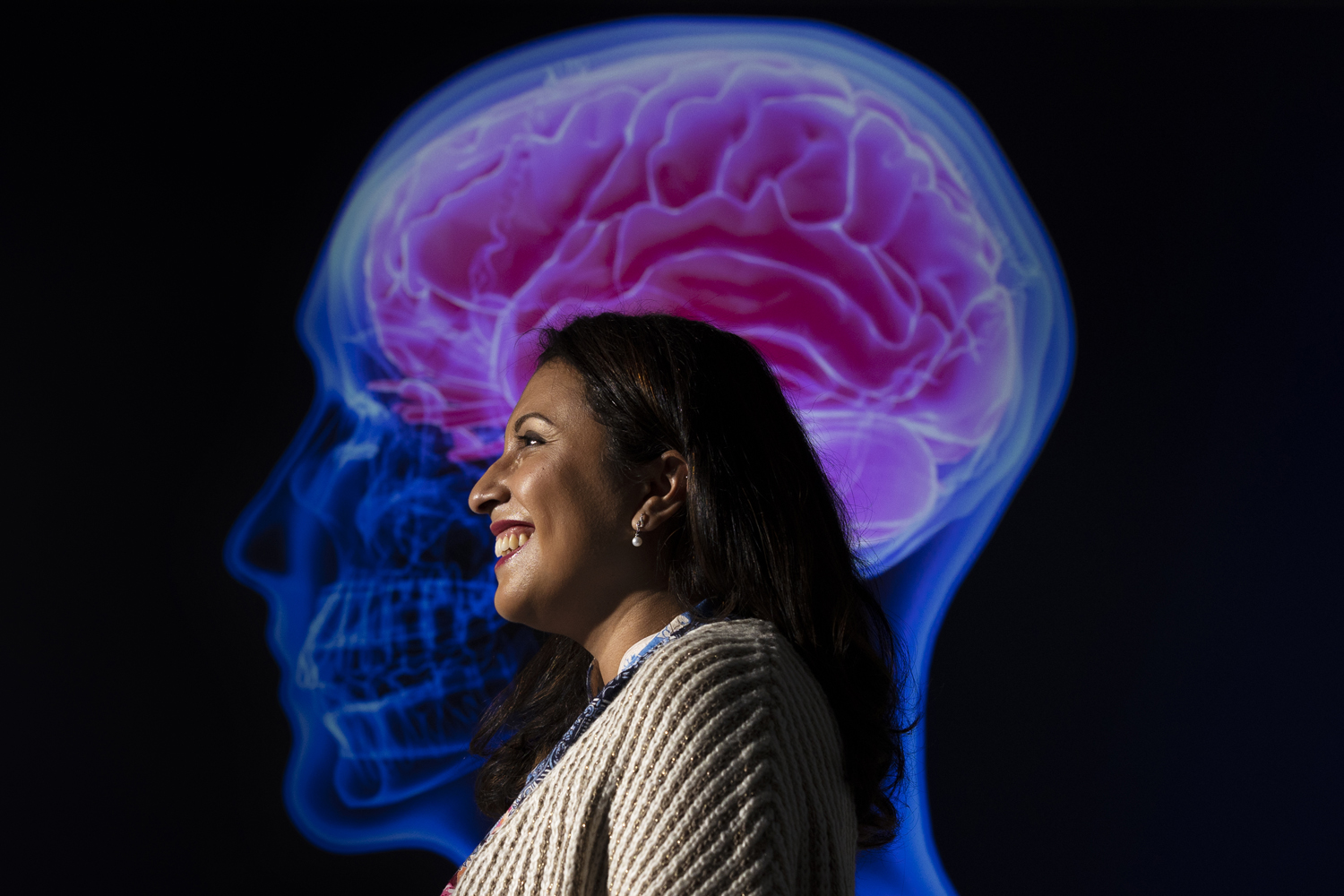
The mathematical puzzles that arise when modeling neurodegenerative diseases fascinate Tanya Garcia, who hopes to solve them to speed treatment development.
February 16, 2023
23-24 Magazine · Health · Society
Listen to the story below:
When Tanya Garcia was a child, her mom would give her math lessons, reviewing many of the basic principles learned at school. After a while, she’d tell Garcia to go play outside for 30 minutes or so — but Garcia remembers begging to come back in after just 10.
“I want to learn more math!” she’d say.
And so, she did.
Fast-forward to 2000, when Garcia went on to pursue a bachelor’s degree in mathematics at the University of California, Irvine (UC-Irvine). During her sophomore year, she took a probability theory course that introduced her to modeling random processes like disease outcomes. One day after class, she went to her professor’s office hours to chat more about a problem he’d presented. He gave her an assignment: to model the infection rate of a disease within a certain population.
On her afternoon commute home to Costa Mesa, just 15 minutes away, she sat in bumper-to-bumper traffic and pondered the problem. She considered factors beyond the infection itself: births, deaths from other causes, travelers in and out of the city. She became lost in the details until she figured out the answer. Overcome with joy, she snapped out of her statistical trance to discover she had driven two hours to Los Angeles.
“My roommates were worried about me. After that, they’d often tease me and say, ‘Tanya, don’t do math in the car. It’s dangerous,’” she says with a laugh.
Even though Garcia had an early — and vivacious — appetite for biostatistics, it took her about six more years to realize her love for the field. But the journey was necessary. After pursuing her PhD across three different countries and completing over 500 hours of leadership training, she landed at the UNC Gillings School of Global Public Health in 2020.
Now, within the Department of Biostatistics, she finds herself obsessed with another problem: using math to make clinical trials for neurodegenerative diseases — like Huntington’s, Alzheimer’s, and Parkinson’s — more accurate and effective. And if she can solve this puzzle, her work will revolutionize the way clinical trials are created and conducted for any disease.
Biostatistics beginnings
Statisticians develop models to analyze data. Biostatisticians do the same, but their models answer questions in medicine, biology, and public health. How quickly will a disease spread throughout a population? How does obesity affect the onset of other health issues? How successful will a new treatment be?
Statistics has been a major facet of research since the evolution of modern science. In 1722, when physicians were experimentally — and controversially — infecting people with smallpox in an attempt to build immunity, London doctor John Arbuthnot estimated and compared the chance of contracting naturally occurring smallpox (1 in 10) to the chance of dying from inoculation-induced smallpox (1 in 100).
In the 1830s, French clinician Pierre-Charles-Alexandre Louis pushed for using the “numerical method” in medicine and collected enough data to show that bloodletting — the removal of blood to prevent or cure illness — was doing more harm than good.
In the mid-1800s, Gregor Mendel used statistics to unpack his data on pea plants, which helped create the field of genetics. A few decades later, geneticist Reginald Punnett created the famous grid every modern-day high schooler is exposed to in biology class, the Punnett Square, to predict genotype probability in offspring.
The list goes on and on, but the field of biostatistics wouldn’t truly develop until the early- to mid-20th century. Today, biostatisticians ensure that enough — and the right kind — of data is collected to help experts in other fields create effective research projects. They don’t just crunch numbers. They assist with study design, analyze and interpret data, and develop models for clinical trials.
“We need expert scientists in the field — like the virologists during the pandemic — but they don’t work alone,” Garcia says. “They design the experiment. Once they have the data, they need to make sense of it. And that falls onto the biostatistician’s shoulders.”
The no-model model
Even though she was briefly introduced to biostatistics back at UC-Irvine, Garcia never realized there was a whole field out there waiting for her. After enrolling in the statistics program at Texas A&M in 2008, she knew she’d found her niche.
While there, she worked under the guidance of Yanyuan Ma, a statistician heavily focused on theory. But one of Ma’s projects involved collaborating with a researcher who specialized in Huntington’s disease — an inherited illness that degenerates nerve cells in the brain — and developing models for clinical trials.
“It blew my mind,” she admits. “Before that moment, it had never occurred to me that math could help health.”
Now, as an associate professor in the UNC Gillings School of Global Public Health, Garcia and her lab use data from observational studies of people with Huntington’s disease to create models of their symptom trajectory and to determine when the disease onsets.

Because Huntington’s disease is genetic, researchers can track and monitor people with the illness over time, collecting a lot of data along the way. But the age of onset varies from person to person, so developing a model of the illness’s progression is difficult. Knowing how symptoms change over time is vital to determining when to begin testing treatments in clinical trials.
This problem isn’t limited to Huntington’s. Similar challenges occur with Alzheimer’s and Parkinson’s.
“With Huntington’s, we’re guaranteed that patients will receive a clinical diagnosis because it’s purely genetic. In math speak, the time to diagnosis is finite,” Garcia says. “With Alzheimer’s, for example, you don’t know if they will develop it because, as far as we can tell, the cause is not purely genetic. So in that case, the time to diagnosis is infinite. But whether it’s finite or infinite, it’s the same problem. And we’ve been working on methods that can handle both.”
To begin tackling this problem, Garcia and her team used data on how symptoms of Huntington’s change over time, before and after a clinical diagnosis — information that determines how many patients to recruit for a clinical trial. If time to diagnosis is inaccurate, then the entire study is a bust.
But what if that information is irrelevant? What if there’s a way to build a clinical trial without it?
That’s what Garcia and her team are exploring using a 100-year-old mathematical concept called Hilbert space theory.
Using the theory, the time to diagnosis for Huntington’s disease is considered a “nuisance parameter,” which is exactly what it sounds like: Something that’s in the way. A nuisance. On each side of the nuisance, though, are dimensional “spaces.” One is heavily impacted by the nuisance; the other isn’t.
The latter is what helped Garcia create an estimator, or a placeholder of sorts, for the symptom trajectory. Once she did that, she discovered that even with the wrong nuisance parameter — a.k.a the wrong time to diagnosis — a researcher could still conduct a successful clinical trial. This is called a model-free method.
“In statistics we call this ‘robust model to specification,’ meaning that even if this model doesn’t align with your method, we’re still able to get the correct results that you need.”
Garcia admits that she’s received some criticism about using such an old theory to address a modern-day problem. But the theory is foundational to her field for a reason.
“Think about the lithium-ion battery,” she says. “The lithium-ion battery was created decades ago. But until we knew how to use it the right way, we couldn’t make electric cars. Hilbert space theory is old, but we’re using it in a clever way that’s creating this cool solution for our problem.”
Garcia’s method still needs to be applied to the clinical trial space, but if successful, it should work for diseases beyond Huntington’s — and numerous other scientific challenges. It could be used as a starting point for biologists who want to study how age affects mating without knowing age, astronomers who want an alternative to brightness for documenting stars, and environmental scientists who want to observe how drinking water contaminants below measurable levels affect livestock.
If at first you don’t succeed, try, try again
Garcia’s research could be a game-changer for studies involving hard-to-measure variables — a success she contributes to her team and her own personal growth.
After graduating with her PhD from Texas A&M in 2011, Garcia went on to become an assistant professor of biostatistics. By 2015, she realized she wanted to move back to California to be closer to family. She applied to six different positions — and received no offers.
She felt like she’d traveled back in time, to that day when she failed her qualifying exams. But just as she did then, she pressed onward. She enrolled in a leadership program and underwent 500 hours of training — and learned how to be herself.
“I realized that I don’t have to pretend to be somebody else to be a leader. I just need to recognize my own strengths and to express them. And I can hire people to help me with the things I’m not good at. There’s nothing wrong with an Olympic athlete having a coach. I’m an Olympic academician, so I got a coach.”
In the years following completion of the program, Garcia was awarded a fellowship from the Mentoring Institute for Neuroscience Diversity Scholars, received tenure at Texas A&M, and was the plenary speaker at the International Symposium on Forecasting, a prestigious statistics conference. In 2018, the chair of the UNC Department of Biostatistics contacted her for recruitment.
Since coming to Carolina in 2020, Garcia has expanded her lab with a focus on mentoring and recently received a fellowship in the Tyson Academic Leadership Program at UNC-Chapel Hill for the 2023-2024 academic year to further strengthen her leadership abilities.
“Upon arriving to UNC, the feeling I’ve gotten from my colleagues and my students is: We see you as the next leader. It wasn’t even a question. It was a certainty. They see the potential in me. And that makes me feel so warm.”
Tanya Garcia is an associate professor in the Department of Biostatistics within the UNC Gillings School of Global Public Health.