
Making Renewables Reliable
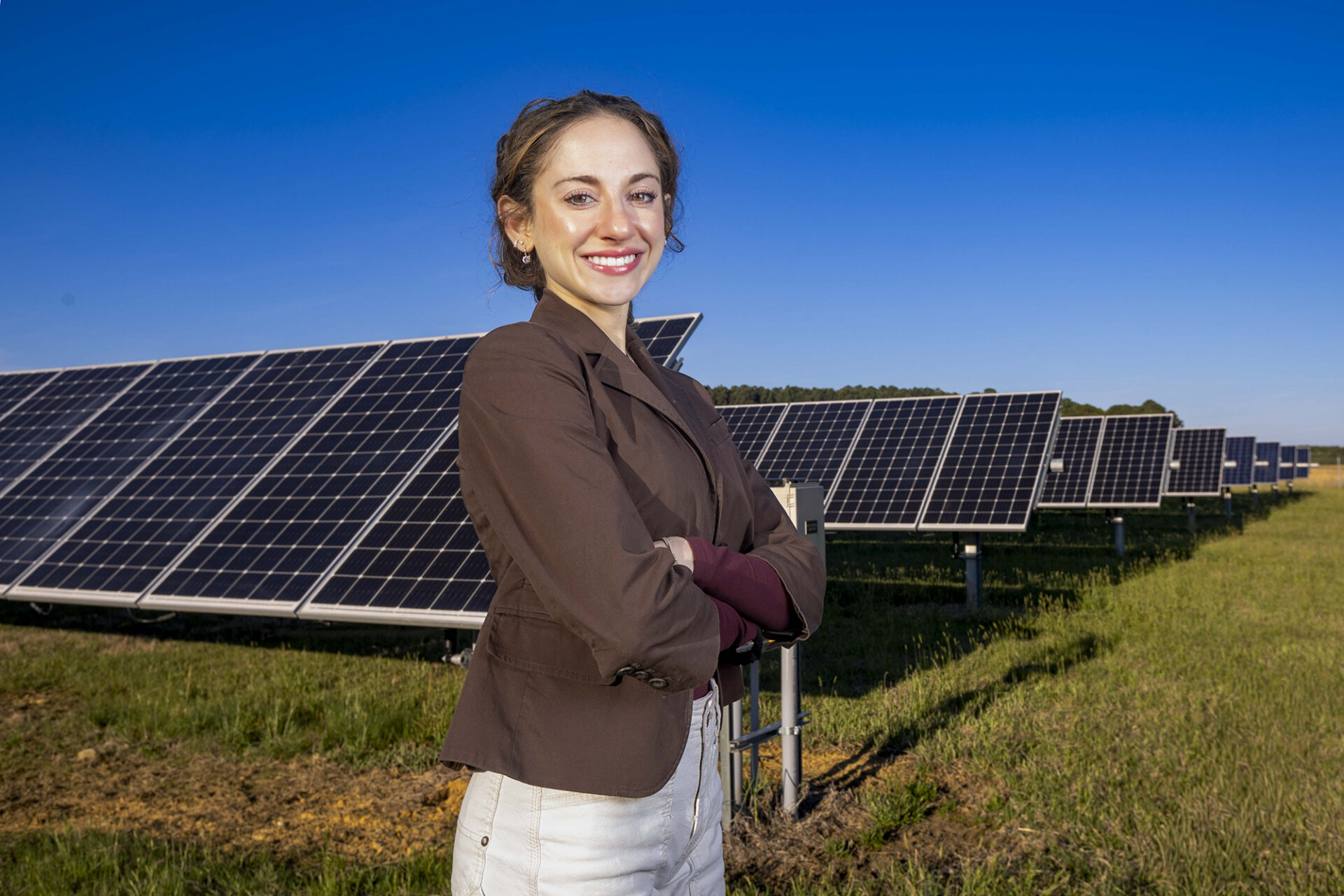
Victoria Farella is reimagining insurance to encourage clean energy investment for a more resilient society.
April 16, 2026
Impact Report

All 21,000 + undergraduate students at Carolina are engaged in research, from the humanities to health care.

Renewable energy is the fastest-growing energy source in the United States, comprising nearly 23% of all electricity generation in 2024, according to the Center for Climate and Energy Solutions.
When Victoria Farella arrived at UNC-Chapel Hill in 2022, she thought she knew exactly where she was headed. A lifelong scuba hobby — something she shared with her stepfather — had pulled her toward marine biology. Protecting oceans felt like the clearest path to protecting the planet.
One lunch meeting later, her vision for a sustainable future took a far deeper dive.
Gregory Gangi, the Carolina professor who taught her first environmental science course, invited her to intern with the UNC Cleantech Summit — the largest university-run clean technology convention in the country. All of a sudden, Farella found herself surrounded by hundreds of entrepreneurs, scientists, and policymakers all motivated by the same question: What will it take to build a clean-energy future?
She didn’t speak the language of renewable energy yet, but the optimism in the room was contagious.
“As a freshman, getting pushed into that is daunting,” she says. “But seeing it all together made me think. For something as formidable as climate change, you need every single perspective, and I really wanted to prove myself. I just said ‘yes’ to every opportunity.”
In 2023, one “yes” led Farella to an internship with a startup making battery components. While she enjoyed the technology, she gravitated toward the people behind it — the founders willing to gamble their time, careers, and savings to move new ideas into the world.
That curiosity guided her to risk management, the art of calculating and mitigating losses across industries from cybersecurity to public health. She learned that the challenges companies face aren’t always about money; sometimes they touch strategy, daily operations, reputation, or even the quality of what they produce. In this work, specialists sift through those possibilities, trace the weaknesses that could cause trouble, and help organizations move forward with confidence and clarity.
For Farella, this meant protecting clean energy investments by promising businesses financial safety nets during inevitable ups and downs in production.
Farella set out to find communities where this approach could build confidence among investors and consumers. Today, she works with the UNC Institute for Risk Management and Insurance Innovation, developing strategies to protect Texas’s power grid against wind energy droughts — periods when turbines slow and renewable power drops.
“I like odd and niche problems,” she says. “While wind energy droughts are cyclical and expected, impacts from exposure to volatile electricity markets are rare and significant for a business’s bottom line.”
Weathering energy droughts
Clean energy suppliers often sign long-term power purchase agreements that lock in a set price for the electricity they generate. This stability reassures buyers, provides suppliers with a steady income, and encourages banks to finance projects before they even go online.
Renewable sources like wind and solar naturally fluctuate due to shifting weather patterns, which can affect energy availability. When energy droughts clash with high demand, utility companies scramble to buy electricity on the open market, where sky-high prices await. These rare but extreme episodes leave customers footing the bill, making investors hesitant to support renewable-heavy grids.
In her early research, Farella came across records of a weather phenomenon known as a “dunkelflaute,” a prolonged period of low solar and wind generation that has led to notable price surges in developed renewable energy markets across Europe and Australia.
Farella wondered whether Texas was any different. Although the state’s climate conditions are unlikely to spawn a true dunkelflaute, it is not immune from extreme weather — or its consequences. During Winter Storm Uri in 2021, electricity prices soared to $9,000 per megawatt-hour compared to an average of $30.
“With changes in weather patterns and greater installations of renewable energy, especially on Texas’s grid, these droughts can happen and can be severe,” Farella says. “I’m looking at how we can keep investors interested, either through an insurance contract that kicks in during those droughts or by diversifying the power purchase agreements.”
By compensating for the gaps in revenue or making them less likely by bundling multiple energy sources, Farella’s framework can make expansion feel feasible.
Adapting for the better
The clean energy transition has faced resistance from workers in the fossil fuel industry, where many fear it will make their roles obsolete. Farella’s research suggests the opposite: The technical skills developed in the fossil fuel sector will be critical to running renewable systems. She emphasizes that this shift won’t happen overnight.
“It takes a measured policy transition, understanding, and empathy,” she says.
That belief aligns with a broader push by some advocacy groups for a “just transition,” which calls for a low-carbon society that feels realistic and fair. Farella realizes that the road to energy freedom starts with behavior change. A life run on renewables may come with new hurdles, but piece by piece, communities can adapt and flourish.
“You can have a lot more autonomy when you’re generating your own power,” she says. “With the democratization of energy, the shift is going to look different everywhere, but that’s the whole point. If we get on a trajectory where emissions start declining, it could benefit so many.”
Powering new perspectives
Through the Cleantech Summit, hosted by the UNC Institute for the Environment and the Kenan-Flagler Business School, Farella has spent four years developing a renewable energy mindset. She’s introduced speakers, built networks, and even interviewed the U.S. Deputy Secretary of the Department of Energy before hundreds of summit guests.
Moments like these remind Farella why she puts in the work. She sees resilience as a guiding principle for change.
“I want to make sure that, going forward, people have a plan and can continue from the challenges that they endure,” she says. “I like giving people that hope.”
Working under her thesis advisors, Farella has learned to question her own viewpoints as deeply as any dataset. Their mentorship, she says, has shaped her as much as her research.
“My mentors advocated for me, and they gave me the confidence to advocate for myself,” she says.
The girl who arrived at Carolina with a clear-cut path now embraces uncertainty and discovery. “I want to understand and question people to find out how they arrived at their beliefs,” Farella says. “In the beginning, I was full-fledged in my views, which is just not how the world works. I never thought I would have been interested in insurance and risk management, but here I am now.”
Victoria Farella is a senior majoring in environmental science and minoring in data science within the UNC College of Arts and Sciences, with an additional minor in risk management within the UNC School of Data Science and Society.
Special thanks to the UNC Solar Farm for use of their site as a portrait location.