
Game-Changing Climate
Jessica Murfree studies how climate change is reshaping sports and explores how athletes, fans, and institutions can respond.
March 23, 2026
Impact Report

By studying how climate change affects sports, Jessica Murfree informs eco-friendly practices that protect jobs, tourism, and the health of the planet.

Each person traveling to a sporting event generates about 500 kilograms of carbon dioxide — the equivalent of driving a gas-powered car 1,200 miles, according to research from the Sport Ecology Group, a national team Jessica works with.
Weather can make or break a game day. But the climate crisis poses far greater challenges — extreme heat, rising seas, and poor air quality threaten athletes, fans, and support staff alike.
Sports organizations are already adapting, often at enormous cost. At the 2022 winter Olympics in Beijing, 100% of snow used for outdoor events was artificial, requiring more than 49 million gallons of water. In the U.S., the NFL and MLB are investing hundreds of millions to retrofit stadiums with roofs.
That footprint extends beyond the field. Turf traps heat. Events generate waste. International competitions require athletes to travel across continents. Stadiums, tournaments, and teams leave their own mark on the environment, contributing to the crisis threatening their continued existence.
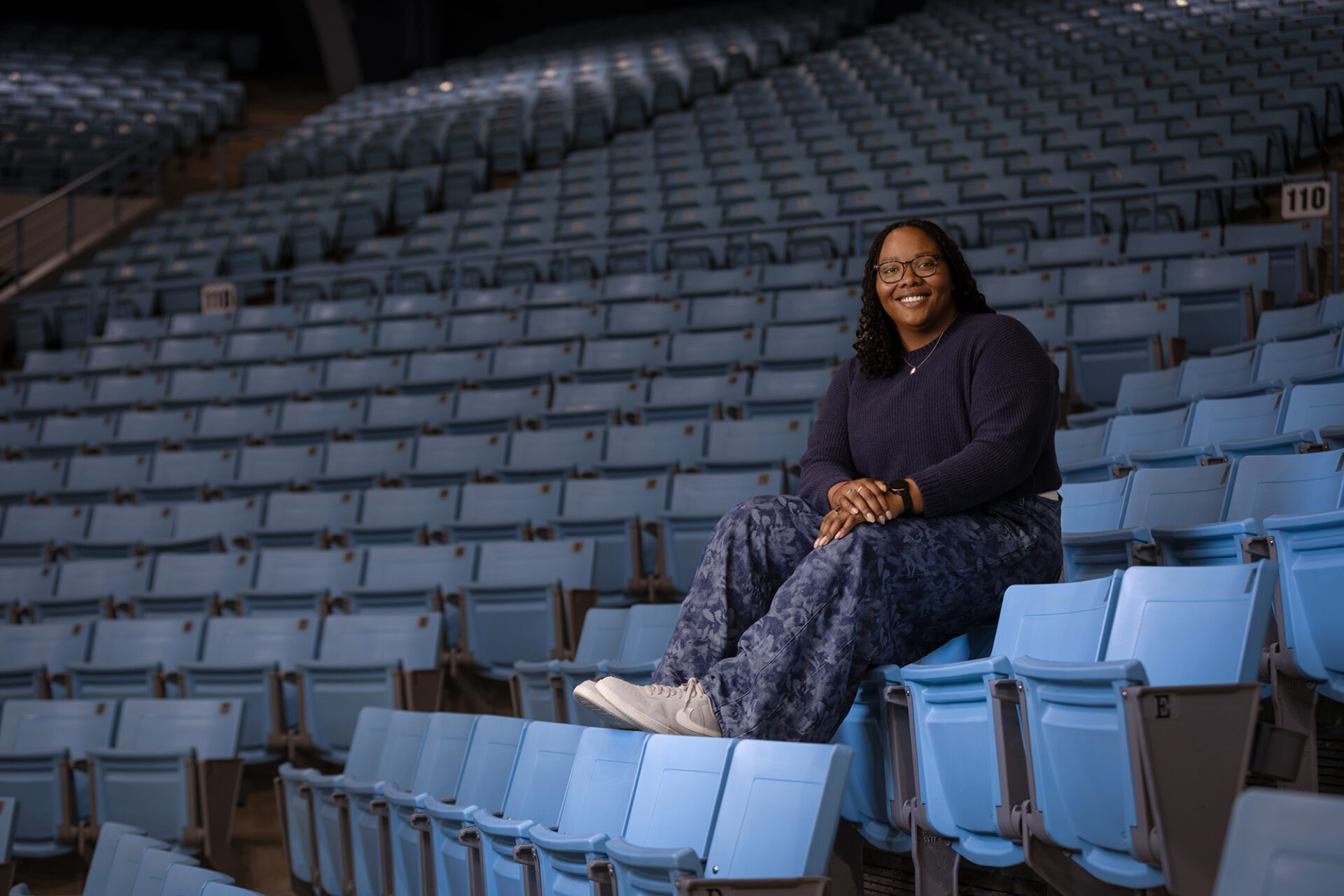
This reciprocal relationship is the focus of sport ecologists like Jessica Murfree. As a professor and researcher at UNC-Chapel Hill, she examines how the sports industry impacts the environment and how environmental change affects sports.
Researchers in this field study everything from biodiversity, waste, and energy consumption to playing surfaces, fan behavior, and athlete health — reflecting the many ways sports and the environment intersect.
“The environment touches everything and everyone in different ways,” Murfree says. “The same is true in how people connect with or experience sports.”
Nature meets sport
As a kid growing up in Atlanta in the 1990s, Murfree spent most days outdoors playing soccer or wandering in a backyard so large she could get lost in it.
“I would pack a little backpack and go explore,” she recalls. “There was a part of the yard that I probably hadn’t been to yet, because it was that big.”
Her appreciation for the natural world kept her moving, a rhythm shared and reinforced by her family.
“We loved playing outside, going to events, and every Thanksgiving would end with a big family game of touch football in the yard,” she says, laughing.
Murfree cycled through nearly every sport available: swimming, tennis, volleyball, horseback riding, ballet, and the list goes on. But soccer was the one she returned to season after season.
Nature and athletics were inseparable for her, threads that would eventually weave their way to Chapel Hill.
“I had Mia Hamm posters on my bedroom wall and ‘Space Jam’ bedsheets,” she says. “And I went to soccer camps throughout the Carolinas. But going to UNC felt like a pipe dream.”
She got in anyway, and in 2015, she graduated with a degree in exercise and sport science. Graduate school drew her to the University of Alabama for a master’s in kinesiology and then to the University of Louisville for a PhD in sport administration. But in 2024, she returned to UNC-Chapel Hill — this time as an assistant professor teaching in many of the same classrooms where she once sat as a student.
Today, she conducts research at the intersection of sports and the environment.
“It’s a relationship that’s both understudied and underappreciated,” she says. “I want to demonstrate the importance of protecting and preserving the natural environment so that we can continue to enjoy sports now and into the future.”
Two paths, one mission
When Murfree arrived at Carolina in 2011 to start her undergraduate degree, her plan didn’t involve sports at all. She always imagined becoming a veterinarian, following in the footsteps of her grandfather, even if it meant hanging up her cleats.
During her sophomore year, she began volunteering in an animal hospital and a lab working with sea turtles and corals — the kind of work she once dreamed of. But instead of feeling inspired, she felt heartbroken.
“It was depressing learning about the climate crisis while trying to get these baby turtles into the ocean,” Murfree explains. “And I didn’t think I should be unhappy before my career even started.”
So, she switched her major to exercise and sport science. While she let go of one dream, she refused to abandon the values that inspired it.
“I was in a relentless pursuit to bring both sides of me together,” she says. “The side of me headed to veterinary school — trying to solve the climate crisis and save the planet — and the kid who grew up playing and watching sports with her family.”
That pursuit led her to notice what many spectators might miss: sports and climate are deeply intertwined.
Reimagining the future of play
At UNC-Chapel Hill, Murfree leads the Action on Climate Change, Environment, and Sport Studies lab. Her research spans multiple sports, environments, and levels of play.
“I am trying to find the sports and outlets that are meaningful to me,” she says. “They might not be the wealthiest, or most visible, but they are personally resonant.”
One of those is scuba diving — a sport plagued by biodiversity loss, rising costs, and safety concerns. Murfree has collected survey responses from nearly 900 divers and is analyzing how they experience the climate crisis firsthand.
“Are they concerned about dive travel becoming more expensive, coral bleaching, seagrass and dune degradation, increasing sea temperatures, arctic ice loss?” she wonders. “How does that affect their relationship with their sport?”
Her lab is also surveying parents of youth soccer players to understand how they make decisions about their children’s involvement. In the U.S., roughly 9,000 high-school athletes are treated for heat-related illness each year — a leading cause of death in young players.
“At what point does it become too hot, even in the state of North Carolina, for kids to continue playing soccer?” Murfree asks.
Large sports organizations like the NFL or the MLB may be able to bear the cost for needed climate adaptations. Construction, operation, and maintenance of the facilities that support these franchises attract significant contributions from private donors but also state and local governments. Between 1970 and 2020 it is estimated that $33 billion in public funds was used to construct major-league sports stadiums and arenas in the U.S. and Canada.
But resources are not evenly distributed across all levels of play. When ponds and lakes don’t freeze, kids who once skated outdoors for free may have to pay for indoor rink time. In warmer regions, some teams can afford shade, water stations, and medical staff to manage extreme heat. Others cannot, forcing families to choose between safety and the chance to play.
As access to recreation and opportunity narrows, Murfree imagines a future where sport is smaller.
“I would put the power back in the community — in parks, in public schools, and in colleges,” she says. “We should put less pressure on making sport as big as it can be and try to make it as accessible as possible.”
Universities are part of this landscape. Positioned between professional leagues and local communities, campuses can serve as centers for innovation and testing ground for ideas that make sports safer, more accessible, and more sustainable.
“These organizations have the responsibility to deliver on what the people want, and what the people want is a long, healthy planetary life,” Murfree says.
But influence isn’t limited to institutions, she stresses.
“If you watch a sport, play a sport, or simply appreciate the environment, there is a place for you in sport ecology,” she says. “There are things you can do today, tomorrow, while you are in school, and after you graduate.”
Jessica Murfree is an assistant professor in the Department of Exercise and Sport Science within the UNC College of Arts and Sciences.