
Empowering Youth for a Resilient Future
As climate change continues to impact daily life, researchers at the UNC Institute for the Environment want to discover the best way to teach the next generation to build a more equitable, resilient society. To do this, they are studying how young people learn about the environment and enact change in their communities.
By Elise Mahon
August 11, 2021
An abnormal heatwave in the Pacific Northwest so hot it melts powerlines. Record-breaking hurricane seasons that bring more severe storms each year. Excessive flooding that forces entire families in Eastern North Carolina to relocate. As climate disasters make headlines more and more frequently, it’s easy to start to feel trapped in a loop of doom and gloom.
With funding from the National Science Foundation, Kathleen Gray is studying how youth learn about climate change and solutions that promote community resilience and turn this knowledge into action within their own communities.
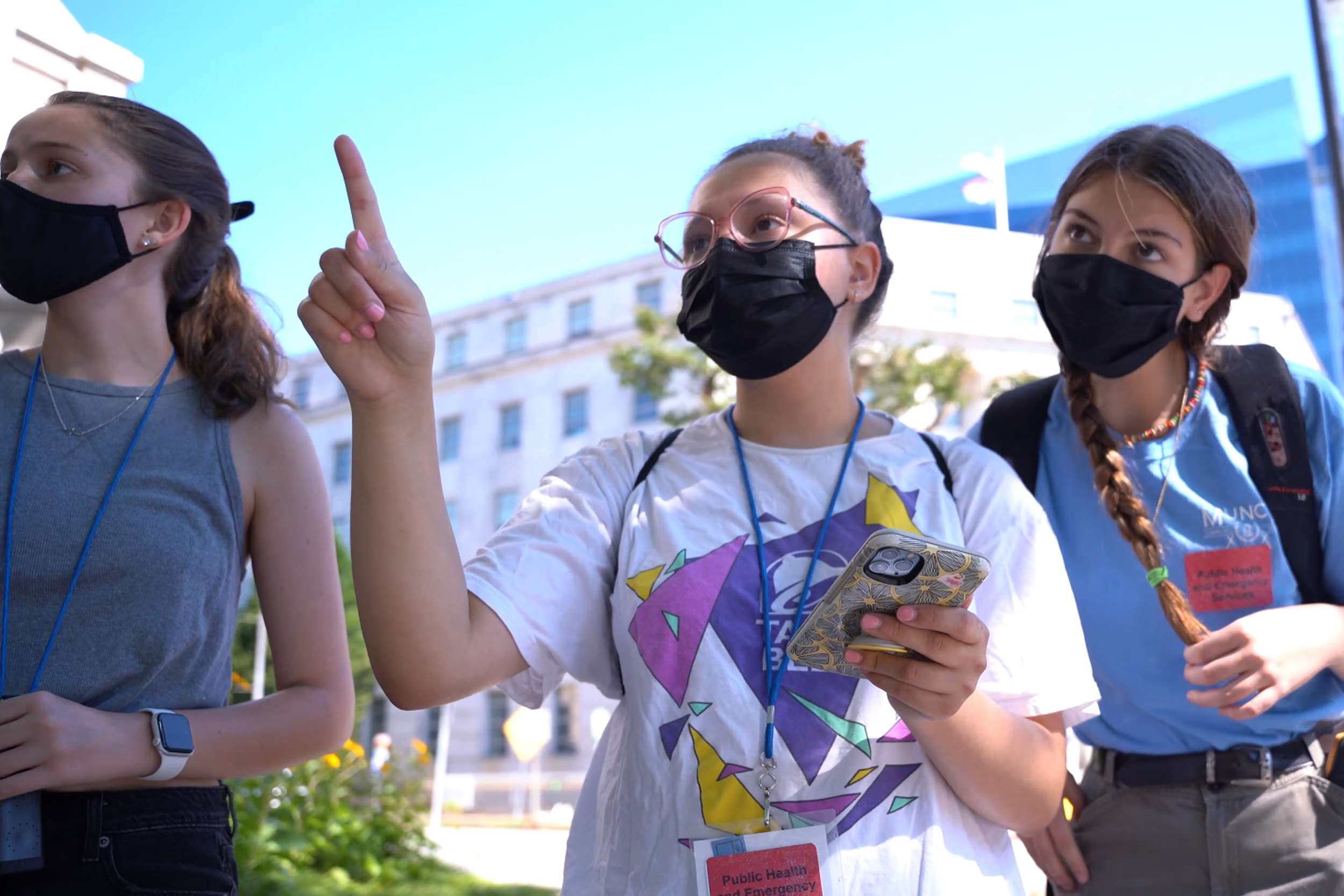
The study involves a partnership between the Center for Public Engagement with Science (CPES) and the North Carolina Museum of Natural Sciences, which joined forces last fall to develop and pilot the Youth Engaging in the Science of Resilience (YES Resilience) program. The program brings together high schoolers from across the Triangle and the southeastern corner of the state to learn about local climate impacts and explore how communities can be designed to be more resilient, with an eye toward promoting equitable solutions.
Gray and the project team are surveying youth to assess how they learned throughout the program and how it helped them realize that they have the power to personally address climate change. The latter was measured through development and implementation of youth-led action projects that some of the participants conducted during the program with the guidance of museum educators. These included planting a pollinator garden, creating social media posts to share information about climate resilience, and constructing sculptures out of trash to promote recycling.
“In North Carolina, we’ve certainly been seeing the impacts of climate change,” Gray says. “If we can raise up a generation of new leaders who are aware not only of the challenges that we face but of creative solutions to those challenges, I think we’ll be in a better position to respond.”
Both CPES — the outreach unit of the UNC Institute for the Environment (IE) — and the museum have a history of creating strong, engaging youth programing. Through this partnership, the institutions were able to pool resources to make for an even more robust experience.
“The museum and the university have these great connections and researchers who want to connect with our audiences,” says Lynn Cross, head of youth programs at the museum. “It’s really beneficial for youth to be able to meet professionals, hear more about their work, and learn about career possibilities.”
In June 2021, after a year of virtual programming, the YES Resilience participants finally met in person to put their new knowledge to work over the course of a three-day institute. When the high schoolers arrived at the museum, they found a grid made of colored duct tape on the floor. Their task? Use their knowledge and lived experiences to build a model city from cardboard boxes and craft supplies that would be resilient to climate disasters and provide as many residents as possible with the resources they would need to thrive.
Resilient solutions such as canals, absorbent pavement, homes on stilts, cooling stations, back-up generators, solar panels, and all-weather shelters were designed, built, and labeled before being placed along a carefully taped-out road system.
“Working with your hands engages your brain in a different way,” says Dana Haine, the K-12 Science Education Manager at CPES. “When you’re doing that with people next to you, it leads to more collaboration and creativity. That’s what we need to solve the problems that climate change is putting on the table for us: different people with different skills and passions.”
The researchers are using surveys to assess the changes in each person’s perception of their ability to impact climate change. They will use this information to create a resilience-focused curriculum that can be implemented in science centers and museums from the North Carolina mountains to the coast and beyond.
“Connecting UNC to non-academic partners in the state really enables us to expand the reach of the university and be a force for good in communities across the state,” Gray says.
Kathleen Gray is director of the Center for Public Engagement with Science and a research associate professor within the UNC Institute for the Environment.
Dana Haine is the K-12 science education manager for the Center for Public Engagement with Science within the UNC Institute for the Environment.
Lynn Cross is the head of youth programs at the North Carolina Museum of Natural Sciences.