
Communication After Concussion
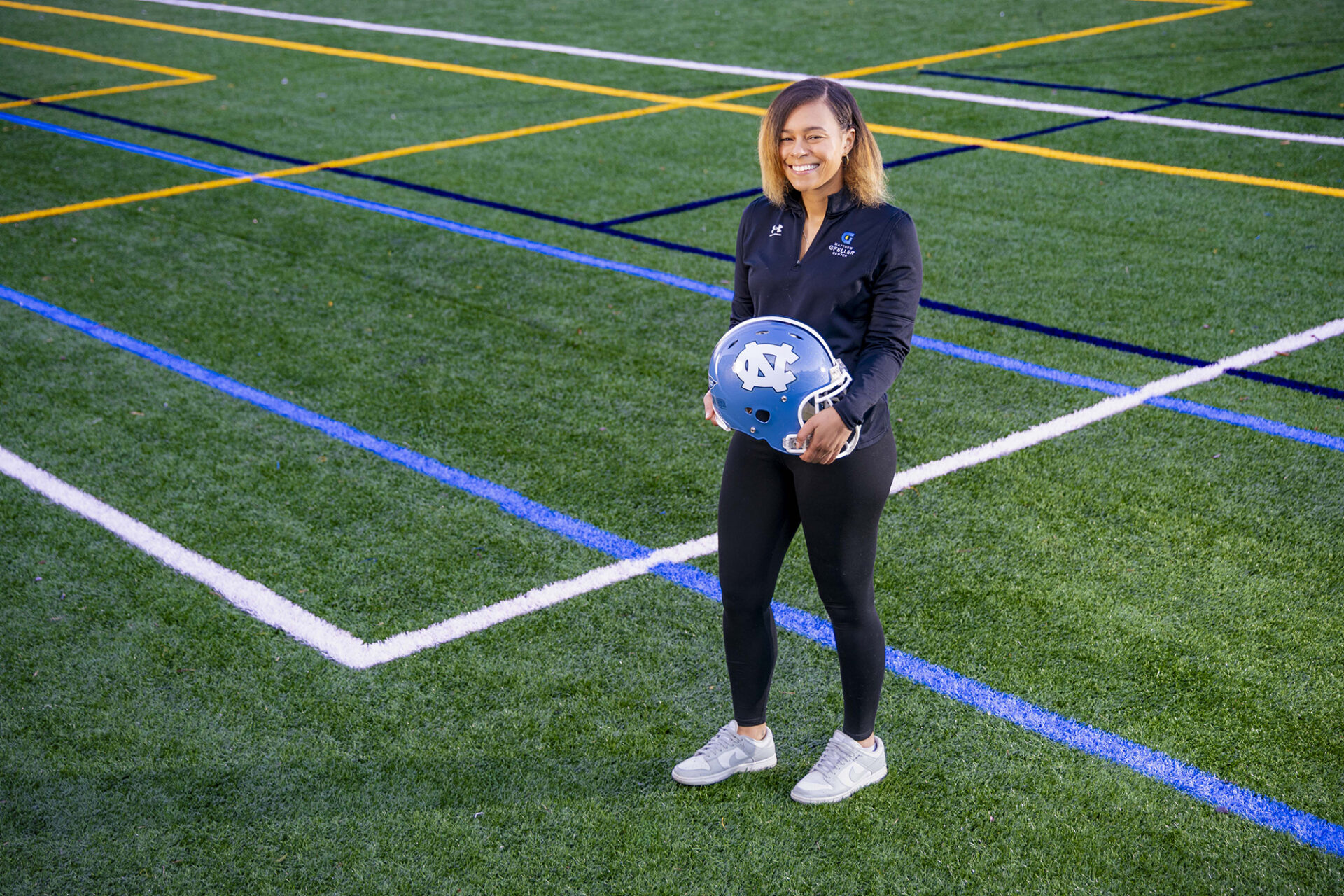
Kennedy Kehaulani Guess is investigating speech and communication disorders caused by traumatic brain injuries in athletes and veterans.
March 17, 2026
Impact Report

The Matthew Gfeller Center at UNC-Chapel Hill focuses on research, clinical care, and education regarding sports-related traumatic brain injuries (TBIs).

Each year in the U.S. as many as 3.8 million people experience TBIs, according to the Centers for Disease Control and Prevention. Of these cases, approximately 10% result from sports and recreational activities.
Kennedy Kehaulani Guess has always been driven by a deep desire to help others, a passion that has shaped every step of her journey.
In 2020, while pursuing her master’s degree in speech pathology, she had a fellowship at an aphasia recovery center, where she supported stroke survivors struggling with language, speech, and comprehension challenges.
“I loved it,” she recalls fondly.
But when she received a text from an unfamiliar number, her research interests took an unexpected shift.
“Who is this?” Guess replied to the message. It was a friend from college who was playing in the NFL.
“You told me if I ever needed anything to call you, so I’m calling,” he explained. They quickly moved their conversation to FaceTime.
“He was sitting in a dark room, which felt ominous,” she remembers. “I asked him, ‘What’s going on?’”
His answer was unsettling: “I hate football. I don’t remember anything. I get confused very often,” he confided.
Guess was shocked that her friend, who was only 23 at the time, was experiencing serious cognitive issues at such a young age.
“I happened to be on a dementia rotation in the recovery center at the time,” she says. “Even the way he was talking to me — his speech, his language — it sounded just like my dementia patients.”
Driven by curiosity, she immersed herself in research on sports-related concussions and traumatic brain injuries (TBIs), determined to help her friend. She soon discovered the gravity of the situation: A study revealed that one-third of former NFL players from 1960 to 2020 believe they have sustained brain damage from their careers.
Athletes in contact sports like football face long-term risks from repeated head impacts. These TBIs can lead to chronic traumatic encephalopathy (CTE), a condition that causes memory loss, dementia, and depression. In some cases, former NFL players with CTE have committed violent acts, which some experts attribute to disease-related brain changes. But CTE can currently only be diagnosed by analyzing brain tissue after someone passes away.
Pursuing her passion to help athletes with TBIs, Guess is now a UNC-Chapel Hill PhD student studying how sports-induced concussions change the way people think and communicate. She hopes to identify physiological, psychological, and behavioral signs that predict long-term brain disorders such as CTE, dementia, and Parkinson’s disease.
“We’re going to start seeing retired athletes in their 40s, 50s, and 60s coming into our clinics,” she says. “We need to focus on understanding what is happening, how to prevent these disorders, and how to help them while they’re alive.”
Combining two worlds
Guess set an ambitious goal: to become a speech‑language pathologist with expertise in sports-induced TBIs. But when she sought out speech professionals specializing in this field, she was surprised to find none.
Undeterred, she shifted her approach and began searching for experts in sport science. This led her to the Matthew Gfeller Center, where she connected with director and head‑trauma biomechanics expert Jason Mihalik.
Now, as a PhD student at the center, Guess is working on several projects involving college and professional athletes.
The first is an NFL‑funded study measuring head impacts among football players across different positions. To collect this data, Guess and her colleagues provided sensor‑equipped mouthguards to the UNC-Chapel Hill football team to monitor how often and how hard each player gets hit during practice.
“A lineman may get hit almost every play, but the impacts are usually at a lower force,” she explains. “A cornerback or wide receiver may get hit less often, but when they do, it’s usually a high‑force collision from another player running at full speed toward them.”
Now, they are analyzing that data and hope to share their findings in the next year.
Another project explores the often‑overlooked challenges NFL players face after retirement. Using numerous interviews with former athletes, Guess gathered insights into their transition out of professional football, the resources available to them, and the changes they experienced.
Through thematic analysis — a method used to identify patterns across interviews — she found that a dramatic shift in identity is one of the most significant struggles retirees face. Many players described a deep sense of loss, often asking, “Who am I without football?”
For those who have played since childhood and suddenly confront the end of their careers, often not by choice, this identity crisis can be profoundly unsettling.
“That is a heavy mental‑health burden for them,” Guess explains. “On top of that, there’s a looming fear: Do I have CTE? Do I have the brain condition I see in other retired athletes? That uncertainty is an added weight.”
The goal of this project is to better understand the retirement process for NFL players and how the transition reshapes their identity, affects their mental health, and influences how they engage with the world.
Guess’s research places her at a unique intersection where she must constantly translate concepts across disciplines — explaining head‑impact biomechanics to her speech-language colleagues and discourse analysis to her advisor in sport science.
“It’s like constantly having to bridge two fields,” she says. “But it speaks to the need in what I’m doing. When you are pioneering something new, you have to make sure everyone is communicating with each other.”
Expanding reach
While working with athletes is Guess’s primary focus, her most recent project examines how TBIs, concussions, and post‑traumatic stress disorder (PTSD) affect veterans’ communication skills.
People with TBIs often have trouble providing clear references in conversation, which can make their statements confusing for listeners. For example, they might say, “Yesterday at the place, we did this,” without specifying what “the place” is or who “we” are.
While their sentences may be grammatically correct, the lack of detail makes it hard to follow their meaning. But standard language tests may not catch this issue, as they focus on grammar and structure.
Guess’s research focuses on a subgroup of veterans with PTSD who receive passing scores on speech, language, and neuropsychology tests yet still suffer from communication and memory issues. She hopes this project will inform assessments that can better differentiate where an individual has communication issues and the role PTSD plays.
Eventually, Guess wants to apply this to the NFL population, as many former players face similar issues. That possibility has deepened her appreciation for the unexpected path her career has taken.
“I’ve opened a whole world that I would have never known about if I hadn’t taken this leap into a new field,” she says. “I just love to learn, even if it leads to more questions. It’s broadening my knowledge and giving me fulfillment, knowing that the projects I’m working on are laying the foundation to help others.”
Kennedy Kehaulani Guess is a PhD student in the Department of Health Sciences within the UNC School of Medicine, a licensed speech-language pathologist, and member of the Matthew Gfeller Center at UNC-Chapel Hill.