
Rooted: Deb Aikat
The journalism professor probes how generative AI is rewriting the rules of a free and democratic press.
By UNC Research
February 4, 2026
Arts & Culture · Rooted · Society
Impact Report

More than 250 UNC‑Chapel Hill faculty are leading over 500 AI and machine learning projects, totaling $163 million in research awards.

About 77% of Americans believe press freedom — reporting information, ideas, and opinions without government censorship — is essential to a healthy society, according to the Pew Research Center.
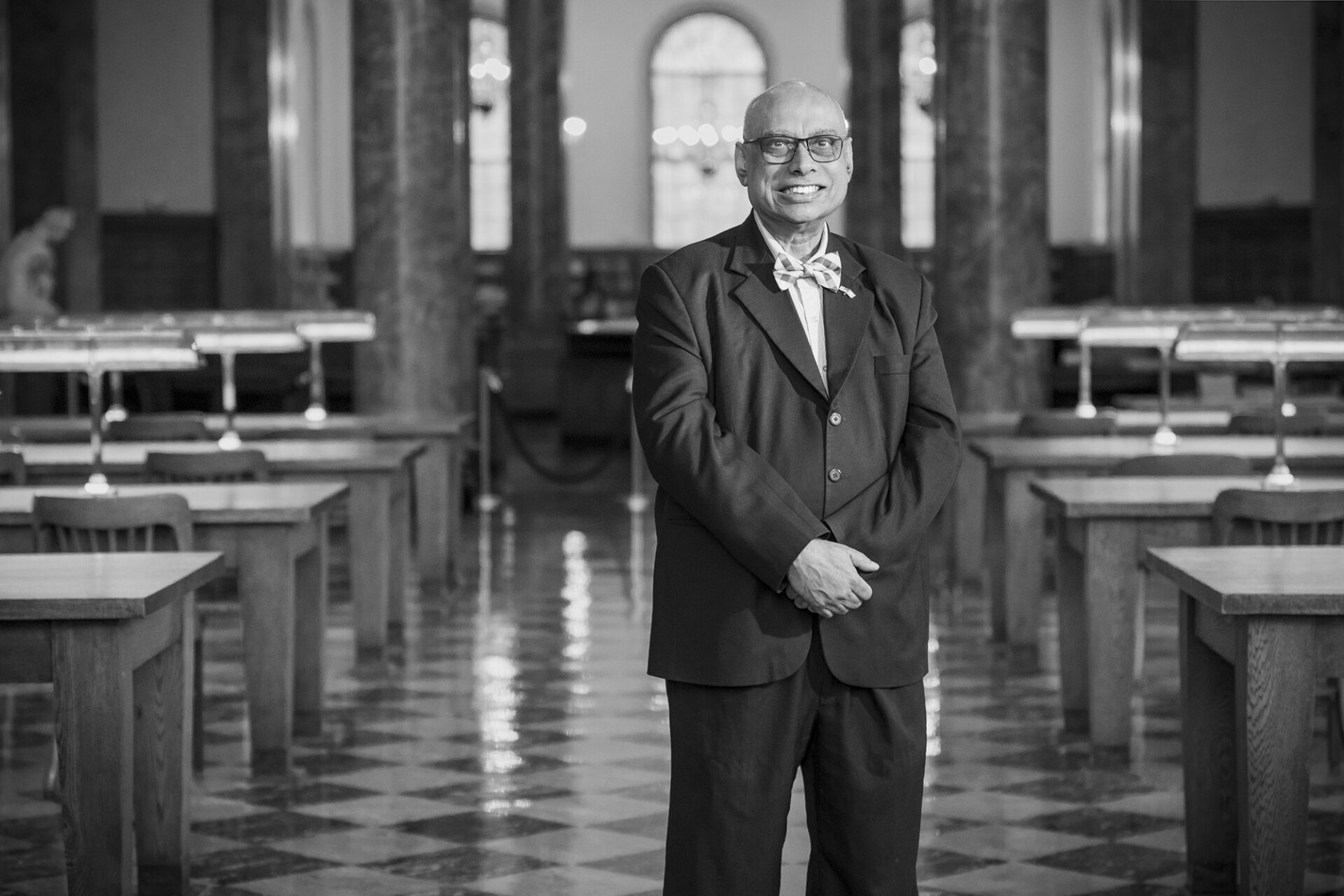
Deb Aikat has worked at UNC-Chapel Hill since 1995, when he joined the UNC Hussman School of Journalism and Media as an assistant professor. Now a full professor, he theorizes how generative AI is transforming the free press as a democratic institution.
What brought you to Carolina?
I cherish Carolina’s success in leveraging research to foster freedom and defend democracy. When I joined the journalism school in the mid-1990s, I taught the school’s first online journalism course and helped lead early online learning initiatives — then called “distance education.” In the early 2000s, I secured two innovation grants and worked with Dean Richard Cole to launch our graduate-level online “Technology and Communication” certificate, which later evolved into the online M.A. in Digital Communication program.
How has your role here changed over the years?
Over the years, I have published key research on digital media, strengthened local and international journalism, fostered partnerships with media platforms and journalists, pioneered digital learning strategies, launched a graduate-level online curriculum, nurtured undergraduate research, led diversity and mentoring initiatives, and earned honors for research, teaching, and service.
As we navigate advances in AI, it is critical to understand how this technology can enhance, propel, and disrupt news and information. My research uses case studies and theoretical insights to illuminate journalism ethics in the age of AI — especially at a time when public trust in media is at a new low of 28%, according to Gallup’s 2025 survey.
I study media platforms in two democracies: India, the world’s largest with 1.4 billion people, and the United States, one of the oldest. My current research covers three areas:
- How the declining reach of legacy news sources and the rise in digital media platforms have transformed democracies and dictatorships. In India and the U. S., media platforms now empower people to protest, publish, and provoke ideas outside of government control.
- Theorizing news agenda-setting for emerging media technologies.
- How India’s burgeoning media landscape is reshaping democracy.
In 2019, I co-authored the book “Agendamelding: News, Social Media, Audiences, and Civic Community.” It explores how people actively blend news agendas from various sources to form their own understanding of issues, rather than passively receiving one media-defined agenda. The book has since inspired new research, including my work on media agenda-melding in India during the COVID-19 pandemic.
What’s kept you at Carolina?
I love working at Carolina. Universities foster hope and remain one of the closest things to a level playing field in our civic society. By generating new knowledge and expertise, institutions like UNC-Chapel Hill fuel innovation, drive the economy, and create jobs that strengthen our communities.
The Carolina community has strengthened my research and teaching, and my work has been recognized nationally. In 1997, I was named Coltrin Communications Professor of the Year by the International Radio and Television Society. In 2004, I received the Scripps Howard Foundation’s inaugural National Journalism Teacher of the Year award for “distinguished service to journalism education.” These are among the highest honors in my field.
Throughout my time here, I have valued leading with a student-first focus, conducting rigorous research, fostering inspirational teaching, mentoring students and colleagues, and advancing a culture of respect, compassion, transparency, trust, accountability, and honesty.
What contribution are you most proud of?
In 2020, my peers elected me to serve as president of the Association for Education in Journalism and Mass Communication (AEJMC), a 112-year-old scholarly organization with members in 43 countries. This four-year leadership role involved guiding AEJMC through pandemic-era challenges, including financial strain, leadership transitions, salary inequities, and declining participation. I worked strategically with colleagues to revive the organization.
Amid political polarization and attacks on diversity, I pivoted AEJMC initiatives to foster academic freedom and support democracy through collegial collaborations and engaged scholarship.
What is a uniquely Carolina experience you’ve had?
At Carolina’s bicentennial in October 1993 at Kenan Stadium — an event featuring then President Bill Clinton — CBS journalist Charles Kuralt (UNC ‘55) famously observed: “What is it that binds us to this place as to no other? It is not the well or the bell or the stone walls. Or the crisp October nights or the memory of dogwoods blooming. … No, our love for this place is based on the fact that it is, as it was meant to be, the University of the People.”
Carolina’s identity as the “University of the People” has been tested throughout the years. But the university’s spirit endures — strengthened by a $1.55 billion research enterprise and overall excellence among the world’s leading public research universities, where faculty inspire students who go on to solve society’s most pressing challenges.
Rooted recognizes long-standing members of the UNC-Chapel Hill community who have aided in the advancement of research by staying at Carolina. They are crucial to the UNC Research enterprise, experts in their fields, and loyal Tar Heels. Know someone we should feature? Nominate a researcher.