
RUNC: Amol Yadav
The biomedical engineer develops technology to treat brain diseases through the spinal cord.
By UNC Research
January 14, 2026
Health · Innovation · Research Uncovered
Impact Report

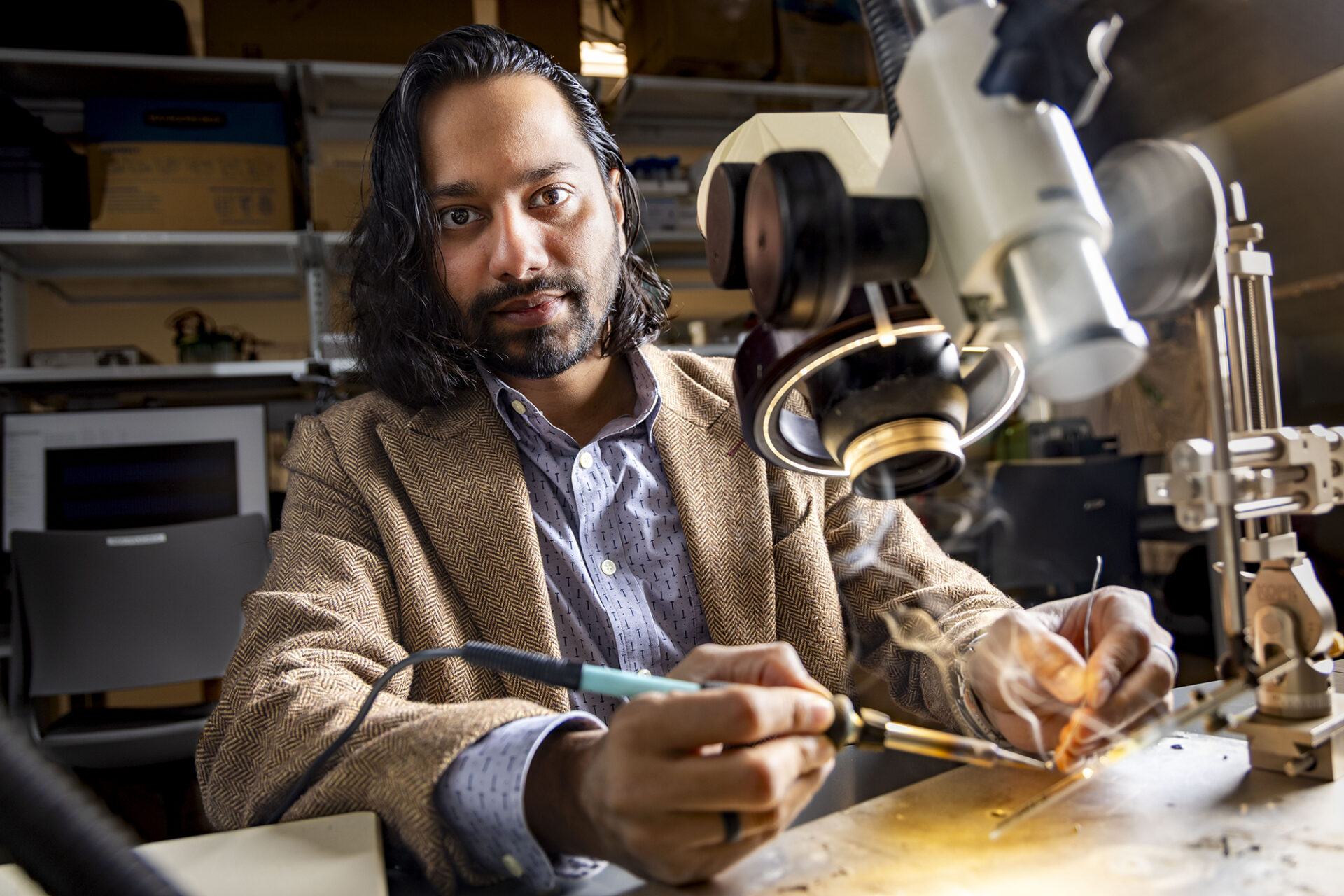
Amol Yadav combines neuroscience and engineering to develop technology that helps people with brain diseases and injuries regain movement and feeling.

Over 1 in 3 people are living with a neurological condition — now the leading cause of poor health and disability worldwide, according to the World Health Organization. Research like Yadav’s could improve lives in North Carolina and beyond.
Amol Yadav is an assistant professor in the Lampe Joint Department of Biomedical Engineering at UNC-Chapel Hill and NC State University and an adjunct assistant professor in the Department of Neurosurgery within the UNC School of Medicine. He studies how the brain and spine interact and develops advanced technology that connects these two systems to help people with brain diseases and injuries regain movement and feeling.
How did you discover your specific field of study?
I learned to meditate when I was 10 and was quite proficient by middle school. During high school, I discovered the Yoga Sutras of Patanjali, which discuss the concept of cessation of thoughts. I always wondered what that means from the perspective of the brain. How could someone be thoughtless or so intensely concentrated that thoughts stop emerging in the ocean of their consciousness? These ponderings during adolescence sparked my curiosity about the brain and its functioning.
As an undergraduate student studying biomedical engineering, I read about scientists who recorded brain activity and used it to control robotic devices. At that time, it sounded like science fiction to me, and that’s how I got introduced to the field of neural engineering. I wondered if, instead of reading thoughts from the brain, we could one day send thoughts or ideas to the brain. This led me to pursue a PhD under Dr. Miguel Nicolelis, the scientist who pioneered the field of brain-machine interfaces.
Academics are problem-solvers. Describe a research challenge you’ve faced and how you overcame it.
How to deliver high-bandwidth information to the brain. One way to achieve this is by implanting electrodes directly into the brain and delivering electrical stimulation — a challenging task. We chose a harder but effective path: sending information to the brain via the spinal cord, the body’s information highway.
To do this, we: develop precision spinal stimulation electrodes, build biophysical computational models of the spinal cord for in silico simulations, and record spinal and brain activity with animal models to validate electrode designs and stimulation protocols. We hope to translate these results into human clinical trials.
We consider ourselves “man-in-the-middle” agents who tap into the spinal cord to intercept the communication signals between the brain and the body, code-break the signals to decode them, and insert our own signals so that we can influence the brain without it even knowing that we are involved.
Describe your research in five words.
Tapping the spinal-neural highway.
Who or what inspires you? Why?
The joy of scientific discovery and the reward of seeing the direct impact it can make on the world. I am fortunate to be in a unique position where I not only develop neurotechnology but also see its immediate impact on the patient population.
For instance, we recently demonstrated that our spinal cord stimulation technology improved gait freezing — the sudden inability to move — in a patient with Parkinson’s disease. He experienced episodes of this while walking, which hindered his ability to navigate his garage and work with tools. It was rewarding to witness our technology improve his gait over the course of three days of continuous stimulation.
If you could pursue any other career, what would it be and why?
A detective. I love to identify patterns in data, situations, or behaviors and connect the dots to see the big picture emerge. Even though the discovery of truth and solving complex puzzles drives me, I don’t think I’d have the patience for that kind of bureaucratic paperwork.
Research UNCovered delves into the lives of Carolina researchers from all disciplines and career levels, showcasing not only their research prowess but personal experiences in academia and beyond. Read more RUNC features here.