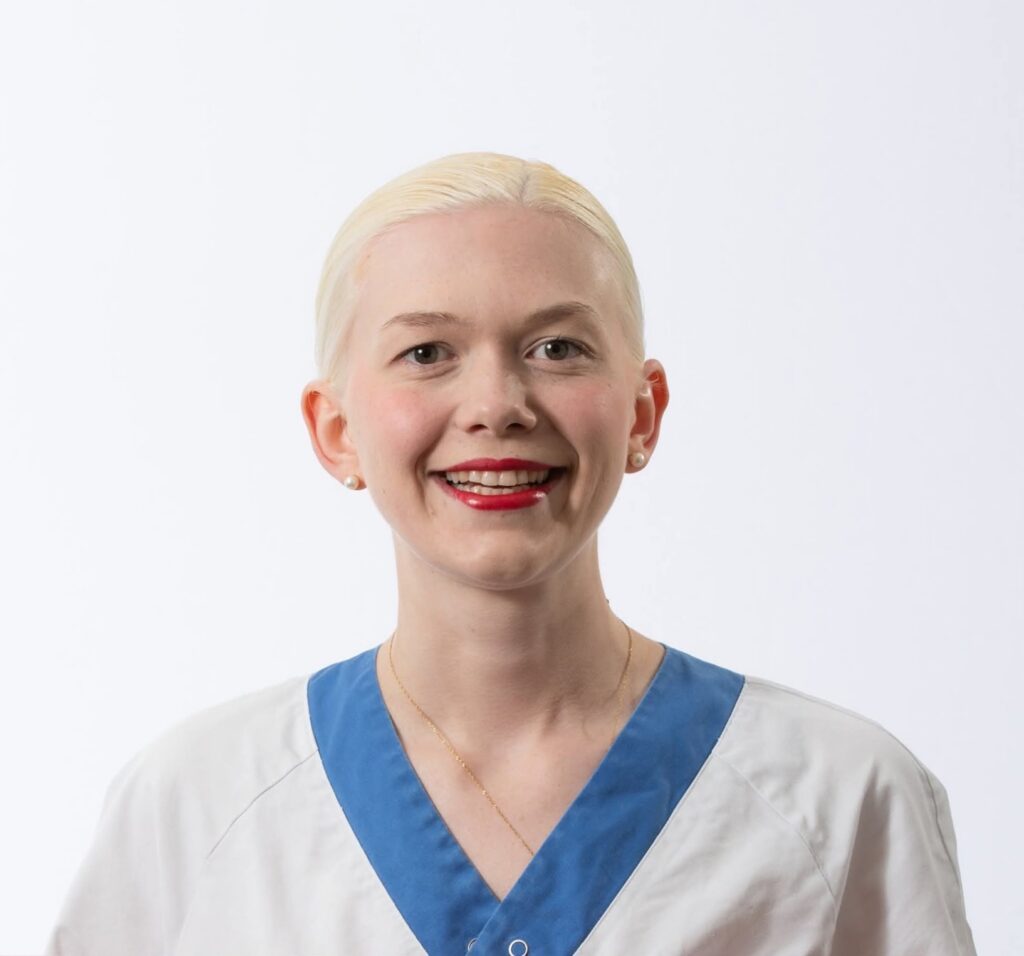
How are you?
Wonderful, thanks for asking! I am trying to enjoy as much of North Carolina as possible before my move home. This includes eating fried chicken, enjoying some pool time, quilting, singing in my choir and doing research in my lab here at UNC.
Please introduce yourself. What should the world know about Alice Hoffsten?
I am kind of the black sheep in my family. Unlike my parents and sister who are all artists, I decided to go into medicine. It has been such a fun and interesting career path! I have also recently realized that my life is not so different from my family’s. I, like them, work project-based and apply for grants. A researcher needs to be creative, and there is a lot of trial and error. A scientist must be able to present ideas in a way that engages the audience, with an eye for color and symmetry. I’m from Sweden and earned my medical degree from Uppsala University. Founded in 1477, it is the oldest university in Scandinavia and is a center of excellent education and research. During my studies, I did a research project with two neonatologists, Dr. Richard Sindelar and Dr. Laszlo Markasz. When I finished, they asked if I wanted to pursue a PhD. Looking back, it was one of the most life-changing decisions I have ever made and one of the greatest gifts I received from my time in Uppsala. That, and of course and meeting my husband Elias in medical school. I work clinically as an emergency physician at Vrinnevi Hospital, in Norrköping, Sweden, and combine this with research on NEC, described below. I would describe myself as a happy and curious person, and people think I have a lot of energy. I am a bit of an “old soul”, who enjoys opera, symphony orchestras and knitting. My new hobby is quilting, which I have learned from talented ladies here in Chapel Hill. I love travelling, and try to pack in as many museums and walking tours as possible when doing so. The world is a fascinating place, with so much to explore and learn. I am grateful to my parents who opened my sister’s and my eyes to the world and the people in it.
In simple terms, can you tell us about your research and the questions that inspire and motivate your work?
I study an intestinal disease called Necrotizing Enterocolitis (NEC). It primarily affects preterm infants, i.e. babies that are born too soon. NEC is associated with high mortality and infants that do survive often live with life-long consequences. Even though we have known about NEC since the 60s, we still don’t know exactly what causes it, and there is no specific treatment for it either. I became interested in NEC when I did my very first research project as a medical student. I was looking at causes of death in preterm infants and trends over time. When I finally looked at the dataset, NEC clearly stood out. NEC accounted for an increasing proportion of deaths over time. Ever since, I have not been able to let NEC go. My PhD and postdoc have focused on trying to understand NEC, why some infants get the disease and try to find ways to diagnose before it’s too late to do anything about it. At UNC, I have learned to work with human intestinal organoids, which are “mini-intestines” that we grow in the lab. We can induce NEC and investigate what causes the disease and explore therapeutic targets. I am deeply grateful for the opportunity to learn these new technical skills from my talented and patient lab colleagues.
Your postdoc at UNC has been a purposefully time-limited, one-year experience. What brought you to UNC, and how did you make the decision to pursue this opportunity?
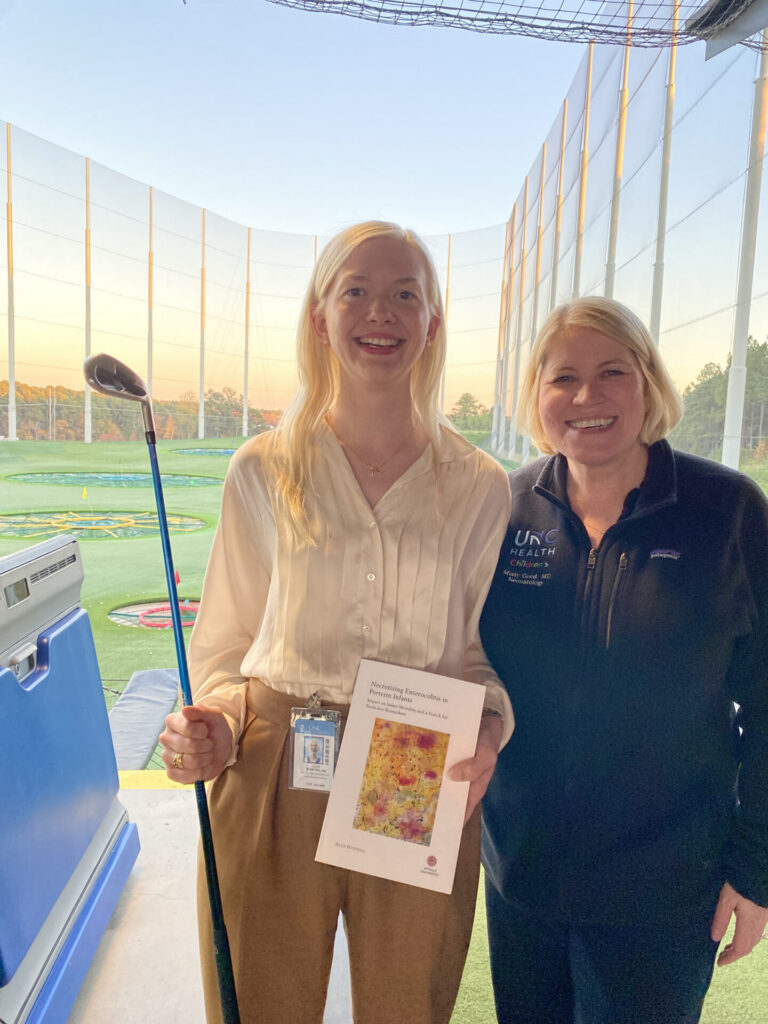
Yes. My clinical job could only let me go for a limited time, and Dr. Good was kind enough to let me come for a short postdoc. I think the time limit has been a great boost. From the very start I knew my time was going to be limited, which encouraged me to make the most of every day in the lab. I get up early and leave work late. If an opportunity comes up to go to a workshop or event, I go for it. I also have a job waiting for me back home, meaning I did not have to spend time searching for the next step, which also makes it more enjoyable. The story of how I met Dr. Misty Good is a great example of how unpredictable academic careers can be. We met at the Pediatric Academic Societies (PAS) meeting in Toronto in 2024. I had a poster presentation, but was contemplating not going, since I was getting married just a few weeks later and a transatlantic trip felt inconvenient. I decided to go anyway. Since I did not know a lot of people, I made a point of going to networking events. I was sitting at a table and Dr. Good sat down next to me. I knew very well who she was and was honored to have the opportunity to speak with her. A half year later I had finished off my PhD, which in Sweden means writing a physical book. I sent a copy to Dr. Good. I learned that my PhD supervisors in Sweden thought that was a bit bold, but I had already mailed it. Lo and behold, Dr. Good reached out and asked if I would like to work in her lab! I guess you never know when you are going to meet your future employer. I had several postdoc offers, but chose the Good Lab due to her prominence in the NEC research field, and since I wanted to explore a new part of the US. Please see image below depicting myself, Dr. Good and the book. I was so touched when I saw she had brought the book to a lab outing we had when I had just arrived in Chapel Hill.
You are an MD working in a research environment. How has your clinical background influenced the way you approach your research, and what do you enjoy about bridging medicine and discovery?
When working as a clinician, I am constantly reminded of why I do research. We want the very best care for our patients. I feel fortunate to get daily reminders of what matters and that there are real people behind the numbers we researchers look at. I think my clinical background also helps in the lab. I can advise about relevant variables to include, how to interpret them and how to think about for confounders. My research also makes my clinical job much more fun. I sometimes feel like I look around at my hospital through different lenses. I think about things we should measure, ways to improve systems and do not feel content with having things as they are just because they have always been that way. I love discussing with colleagues how we can improve systems, or try to convince superiors to measure and improve outcomes. Another benefit of having two jobs, clinical and research-based, is that I never get tired of one or the other. After a while of research, I miss my patients and go into the clinic with new energy, and after a few tough shifts in the Emergency Department it is wonderful to spend some time working in an excel sheet or writing a paper. I just love it!
During your time here, I know you have been very intentional about taking advantage of professional development opportunities. What has your experience been like with UNC’s postdoc training ecosystem, and what are some of the most valuable things you’ve taken away from it?
I sure have, Alan! I remember you once said “Alice, you never miss a workshop, do you?” I thought to myself “Well isn’t everyone taking part in all these amazing workshops?” They are phenomenal! I respect that postdocs have other obligations, but if you have the opportunity to attend workshops, and your PI is kind enough to let you go, I highly recommend them. They allow you to learn about things beyond theory and technical skills. This is essential for a successful career. We learn about mentoring, teaching skills, networking, how to write a teaching statement, how to explore career paths in academia and the private sector, how to understand if being a PI is something you want to do, and much more. The wonderful OPA team is always happy to answer questions and offer guidance. Being an international postdoc, this has been a huge help in navigating academic life. I now feel confident in what I want to do for the future, what suits my abilities and aspirations, and what steps I need to take to get there.
You’ve spent time working in both Sweden and the United States. What differences have you noticed between the academic and research cultures, and what has surprised you most about the experience?
One of the first things I noticed is the structure around mentoring. In Sweden, superiors help you in your career, too, and I have been fortunate to have excellent mentors. In the USA it seems more formal, verbalized and that people take mentorship very seriously. It is not uncommon for people at conferences or universities to explicitly ask whether they can serve as a mentor, and there are often clear structures, sometimes even contracts, around the mentoring relationship. I wondered why people bother so much with helping us youngsters, and my cynical side wondered what the catch is. With time I have learned that there is a culture of mentorship and that mentors simply do it because they like to help. That is very nice, I think. I also noticed the formality of things and that titles seem to matter more in the USA. Back home in Sweden, I am just “Alice” both in research and when working as a physician, but here in the USA it’s officially “Dr. Hoffsten” and the “MD PhD” seems to mean more. Then there is of course the politeness. I was surprised when people said “Yes m’am” to me. I felt so old. I now understand people are just very courteous. People hold up doors for you, everyone thanks the bus driver when getting off and if someone bumps into you they actually say “Excuse me.” Finally, and most importantly – people in the USA are so friendly and very easy to talk to. It’s great and something I will really miss!
Beyond the lab, what has been a highlight of your time living in the Triangle? Is there anything you would encourage other postdocs to explore?
Explore the museums and botanical gardens, here and in Durham. Take a drive on the Blueridge Parkway, preferably in the fall when the leaves are remarkably beautiful. Asheville is a fun town and the USS North Carolina in Wilmington is a very cool battleship. I have also made a point in discovering neighboring states, a total of 7! My favorite areas are Savannah, GA and Charleston, SC, which both make good weekend trips from Chapel Hill.
What’s currently on your read, watch, or listen list?
I am reading “Medical Apartheid” by Harriet A. Washington and watching “The Pitt” to get me into the mood for returning to my ER job. Right now, I am listening to a lot of Swedish national romantic composers, Wilhelm Peterson-Berger, Hugo Alfvén and Wilhelm Stenhammar. I do miss home and look forward to enjoying Swedish summer.
Looking ahead, what’s next for you, and where do you hope to see yourself in the next five years?
I am diving right back into my job as an emergency physician, starting at 7:45 just a day after arriving. Besides that, I have been voted into two boards of directors, which I am very excited about. These are the Swedish Society of Emergency Medicine (SWESEM), and the Regional Research Board in my home state, Östergötland. I am going to continue doing research about NEC at Uppsala University with my pervious supervisors, and also with a new collaborator. In addition, an opportunity has arisen for me to conduct research in my Emergency Department, where I would also have a supervisory role mentoring our resident doctors in the research projects they do as a part of their residency. I am looking forward to all my new roles and hope to contribute in a positive way. In five years, I hope to have contributed to the field of NEC research and that we will see better outcomes for our patients and patient families. Academically, I hope to have earned the Swedish title “Docent,” which translates to Associate Professor.