How are you?
I am doing great! I have actually been enjoying the colder weather we’ve been having this winter and progress is being made in the lab. All is good!
Please introduce yourself. What should the world know about Jacob Gordon?
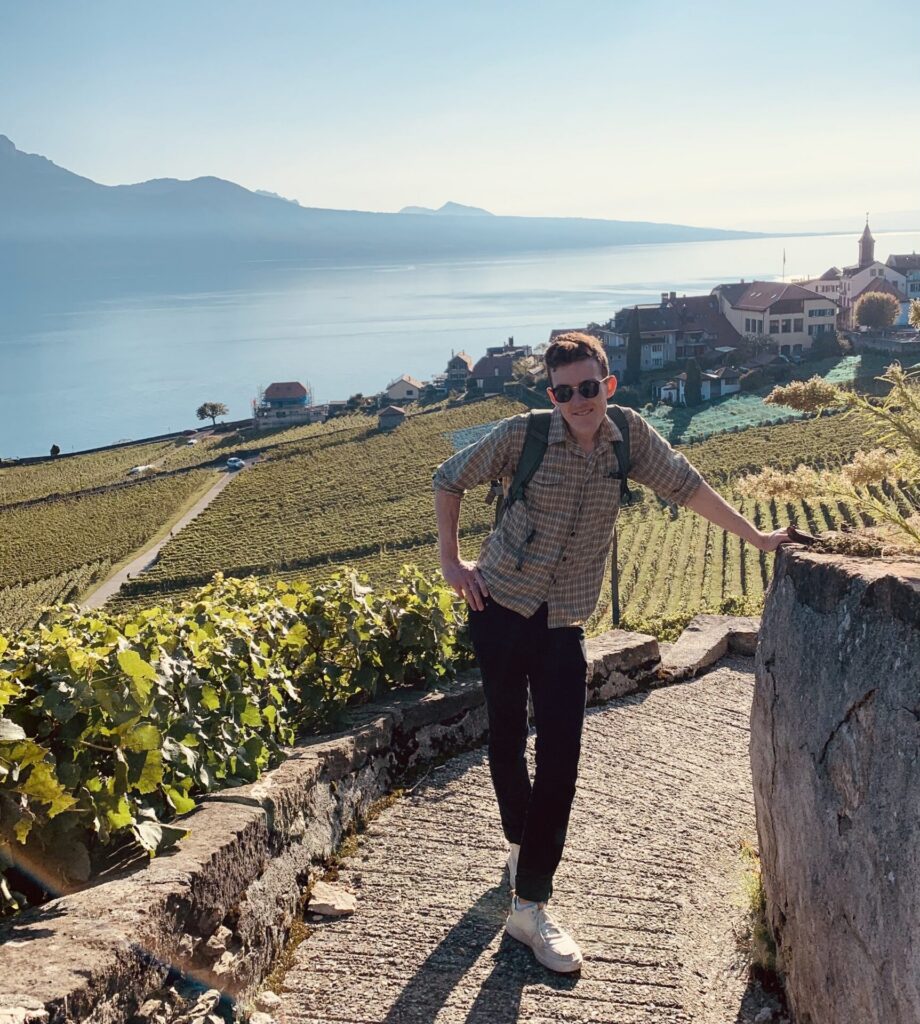
Professionally, I am protein biochemist who loves the freedom of exploration in basic science research. More personally (and more importantly), I am a husband to a UNC family medicine resident and a father to our 15 month-old daughter. So life is VERY busy but all with amazingly positive things! I am a born and bred North Carolinian and have quite a bit of state pride. I am from Stokes County North Carolina which is on the eastern side of Southern Appalachia. People might not be familiar with the county name or location but are often familiar with famous NC landmarks like Hanging Rock and Pilot Mountain State Parks which are part of the county’s geography. I could see both of these landmarks from where I grew up! I was raised on my family’s farmland where at least 5 previous generations of my paternal family lived. Historically, my family farmed tobacco as that was a major agricultural product for the state in the 20th century. This waned at the turn of the century, and many of the old tobacco fields are now hay fields or pasture. Much of my family still lives there and I try to spend time there with my own family as much as possible! My maternal side of the family is from deep Appalachia on the NC/TN state line, and I visited them often growing up. These communities influenced my early life greatly, likely causing my natural attraction to the NC Appalachian region and the outdoors in general. So I guess it should be no surprise that I attended Appalachian State University in Boone, NC for college, where I graduated with a B.S. in Biology in 2018. My undergrad years were extremely influential in shaping many aspects of my present life including what would ultimately be my career trajectory. A few other small facts about me – I am a big outdoor recreation guy and love long-distance backpacking and snow skiing in particular. This love for the outdoors is coupled with a love of traveling both domestic and abroad. I am also a small wine nerd but (hopefully) not the pretentious type. I’m more into visiting the vineyards and places where great wines are made (and enjoying the wine if possible). The picture I included here is of me in the vineyards of Lavaux, Switzerland with the town of Rivaz and Lake Geneva in the background. This was one of several trips in mainland Europe my wife and I took while I was living in England for part of graduate school.
In simple terms, can you describe your current research focus and the kinds of questions that most motivate you in your work?
Throughout all my basic science training I have been interested in how large molecular machines and protein complexes come together in the cell to function. I specifically like being able to look at these assemblies (by solving their molecular structure) and visually explain how they function. Hence biochemistry and structural biology are my main trades, but I also have a fundamental skillset in cell/molecular biology to try and be as interdisciplinary as possible. As I was wrapping up graduate school, one of my projects ended up diving into the Small Ubiquitin-like Modifier (SUMO) field and I became very interested in that. SUMO is small protein that can be conjugated to other proteins in the cell and alter their functions in all types of ways. I think I got interested in SUMO largely because there are so many questions still about SUMO behaving in fundamental functions of the cell, such as gene expression and genome organization. It is always a good thing when there are lots of questions! So now my primary work as a postdoc is investigating basic SUMO function in chromatin, the main region in the cell where our genes are turned on or off. While I am studying this in multiple different ways and from several angles, a huge goal is to visualize how SUMO works by solving molecular structures of SUMO and other SUMO-dependent proteins on chromatin components. I am broadly interested in SUMO biochemistry and structural biology even outside the chromatin context, and these many interests I plan to pursue in my own academic research program in the future.
In 2025 you were selected as the Eshelman Distinguished Postdoctoral Fellow. Can you tell us a little about the Fellowship and how the experience been so far?
The Eshelman School of Pharmacy at UNC established the fellowship recently to recruit competitive postdocs to conduct top tier research with a faculty member within the school. The fellowship is quite young as I am only the second awardee for an opportunity that is posted annually. I learned about the fellowship in the early phases of talking with my now faculty mentor (Dr. Rob McGinty) about pursuing postdoc training in his lab. Since I was motivated and planning on applying to external postdoc fellowships anyways, it made a lot of sense to apply to this internal fellowship as well. As I was coming out of graduate school, I felt confident that I knew my personal research interests for the future, and I wanted to find a postdoc position and mentor that would give me the support to pursue some independent questions. I made my research vision very clear in the fellowship application, and upon being awarded the fellowship and beginning to work at UNC, I feel very supported in my research and the independence I have. Overall, I think the fellowship has so far aided in giving me exactly the postdoc training experience I was seeking, and I am very appreciative to the UNC Eshelman School of Pharmacy for supporting me!
Your training has taken place across multiple research environments, including NIH and international graduate work. How have those experiences shaped the way you approach research today?
This is a great question that I am only just now beginning to think about in my current position. I have had a unique and pretty non-traditional training journey. I was selected as an NIH-Cambridge Scholar to pursue my PhD training. This is an accelerated program that splits the graduate training period between an NIH lab in the US and a lab at the University of Cambridge in the UK. One of my main roles as a trainee in this program was to establish and facilitate a short-term collaboration between two labs. Looking back at that time, in addition to the actual execution of the science, I spent a lot of time planning and anticipating the direction of the projects I was leading. This anticipation element of science I think is the biggest skill I developed that plays a big role in my research approach today. While planning experiments, I would always try to think about all the possible outcomes that could result. Then I would plan all those experiments and try to make sure I had reagents prepared (purified proteins, DNA plasmids, etc…) so I could immediately perform those after the first experiment result came in. Sometimes I would be anticipating multiple experiments ahead. One could reasonably see how this practice could get way out of hand economically (or just not work most of the time because research throws unexpected results at you), but with the number of resources those training institutions have (especially NIH), it was possible, and speed of productivity was a by-product of that. Regardless of resources, I think intellectual anticipation within a research project can be beneficial. I am no longer in an accelerated program that requires speedy production, but to be on the academic career track, productivity is important. I think my training experience has prepared me well for that. One last thing I will add is that while working in Cambridge I was in a lab with a diverse group of people from all over Europe. Observing them, I learned that you can still be productive in the lab while also fine-tuning work-life balance in a way that emphasizes the life part!
One goal of the Eshelman Fellowship is to prepare fellows for leadership across academia, industry, or government. How has the fellowship and your time at UNC-Chapel Hill shaped the way you think about your career or impact so far?
I certainly believe the Eshelman Fellowship is allowing me to be very purposeful in pursuing and preparing for a career in academia. I think this is largely due to me having a good degree of scientific freedom to pursue my personal research interests early as a postdoc. These interests/questions I envision might be part of my own future academic research program, so it is very nice to have the fellowship and mentor support to start testing my core research questions. I have also been very pleased with the research environment at UNC and motivated by how expansive the enterprise is. With the majority of my previous training being in government at NIH (which is quite a different research environment) and abroad in the UK, it was important to me to get operational experience at a non-government US academic institution. I am glad that experience is here at UNC and grateful for the fellowship to allow that opportunity.
Do you have any advice for new postdocs, or things that you wish you had known when you first started?
I am early in my postdoc journey so I am not sure I can give super wise advice just yet! I will say that I have been impressed by the amount of career resources/workshops that are being offered by the postdoctoral affairs office. I am planning on getting started attending the workshops for the academic career track to force myself to start thinking early about the many facets of that track.
Can you recommend any interesting things for postdocs to experience while living in the Triangle area?
I am going to expand on this question to also include experiences elsewhere within NC (like a true biased NC native) but also answer the original question. Outside the Triangle – I am a bit biased towards the western part of the state, and almost all of these things are 3 hours or less to drive to from Chapel Hill. If you’re outdoorsy (or not and you just like beautiful mountains) you need to spend at least a weekend in what NC natives call “The High Country”. This area is centered around the town of Boone and includes a lot of beautiful geography in the northwestern part of the state. Some highlights include the Blue Ridge Parkway and Grandfather Mountain State Park. I always recommend visiting in May/June (when the Rhododendron plants are blooming at peak) or Oct./Nov. when the Fall leaves are in full color. If you’re really adventurous you could go to the Linville Gorge Wilderness Area (just be sure you have a good map). Also (I am taking off my NC fan boy hat for this one), just over the state border in southwest Virginia is the Mt. Rogers recreation area that has Grayson Highlands State Park within it. This is an amazing place for all types of outdoor activities. Lastly, a recommendation that has nothing to do with outdoor recreation and is perhaps a deep cut. If you enjoy wine and/or visiting wine country, you should visit the Yadkin Valley. This is North Carolina’s first AVA (American Viticultural Area) recognized in 2003 and the vineyards/wineries here are making some nice European-style wines that are competing with wines made on the West coast. The region is small and has stayed out of the mainstream wine world, but it is getting more popular. I would recommend visiting Shelton Vineyards in Dobson and Piccione Vineyards in Ronda as starting points. There are many others worth visiting too and the surrounding geography is beautiful! Inside the Triangle – My wife and I recently went to an occasion dinner at Stanbury in Raleigh. It was a fantastic environment and I highly recommend to those who appreciate good creative food and dining experiences. It is one of the best in the Triangle. When I first moved to the area I was a bit skeptical of Umstead State Park due to it being right in the middle of the Triangle and next to RDU airport. However, the more I visited the more I have come to really enjoy this park, especially for casual (or serious) trail runs and hikes. Its a great spot to be so close by. I also think the live music scene is great throughout the Triangle, both big and small venues alike. Cat’s Cradle in Carrboro is legendary, but Motorco Music Hall and The Pinhook are other cool small venues in Durham.
What’s on your current read/watch/listen list?
I am a huge history and non-fiction reading nerd. However, I am an embarrassingly slow reader, so my books read list each year is smaller than I would like, and my stack of books to read gets bigger. My wife says this is because I only read non-fiction and maybe I would read faster if I read fiction which is “more fun” (I have a goal to read one fiction book in 2026). I just finished reading Kazin’s biography of William Jennings Bryan who was an American politician and three-time failed presidential candidate in the late 19th and early 20th centuries. While Bryan is an interesting figure, I think I found more interesting how parts of the American populous back then behaved towards influential political leaders, and how it is very similar to parts of America today. I find it interesting when history reinvents itself in modern day. I also really enjoy reading/listening to The New York Times, especially the opinions podcasts they produce.
Where do you hope to see yourself in the next 5 years?
In 5 years I hope to have my own research program installed in its early phase and active. I also hope I can stay in North Carolina!