
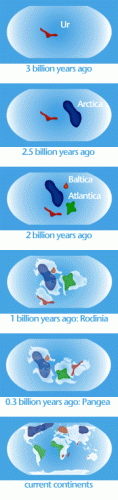
As John Rogers sees it, three billion years is as far back as you can go in studying continents. Before that, they didn’t exist - not by his definition.
Traditionally, geologists determined the age of a continent based on the oldest exposed rock, which is some variety of granite. Because granites constitute the foundations of continents, geologists assumed that any granite found must date back to the continent’s formation. But Rogers, Kenan professor of geology, pointed out that granites were forming and being reworked into the crust before the crust was steady enough to sustain a continent.
“I kept saying that a whole pile of granites that is continually being destroyed is not a continent,” Rogers says. “It’s just a temporary pile of rock.”
Rogers began defining continents more strictly - as large, stable platforms that other rocks could settle on - and it changed the way he determined a continent’s age. Instead of using the oldest rock, he used the oldest stable rock. Then he saw a pattern that nobody else ever had: Continental rock in the ancient supercontinent Pangea was grouped by age.
Pangea was the last supercontinent, a giant conglomeration of all the continents. It formed 300 million years ago when the tectonic plates that make up Earth’s crust modified and rearranged themselves, bringing the continents together. Today, six large plates and more than a dozen small ones float on a mobile layer in the mantle, a zone of rock that surrounds the Earth’s core. Some geologists speculate that currents flow in the mantle and carry the tectonic plates like rafts on a river, but nobody knows why they would assemble into one large landmass.
Geologists think supercontinents break up because they trap an immense amount of heat. Eventually, the pressure reaches a critical point and literally blows the supercontinent apart. When Pangea broke up 200 million years ago, the pieces became the continents we know today.
By re-examining data that he and other people have collected, Rogers calculated the ages of various parts of Pangea. He saw that one area contained three-billion-year-old rock. Another consisted of rocks two-and-a-half billion years old, and two others, two-billion-year-old material. Rogers reasoned that these areas must have emerged as successive continents, which must have remained intact until Pangea broke up.
“It would have been highly unlikely, statistically impossible, for these areas to form as continents, to split up and wander around the Earth for several million years, and to come together as Pangea with the areas that are the same age next to each other,” Rogers says.
Based on his conclusion that these early continents stayed together, Rogers charted their gross movement and development. In January 1996 the Journal of Geology published his paper, “A History of the Continents in the Past Three Billion Years.”
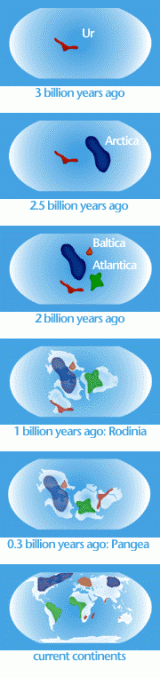
Rogers says Ur was the first continent, formed three billion years ago, followed by Arctica half a billion years later. Another half a billion years passed before Baltica and Atlantica emerged. The four continents roamed separately until, about one-and-a-half billion years ago, Arctica and Baltica collided with what is now eastern Antarctica to form Nena.
When Nena, Atlantica, and Ur came together one billion years ago, the supercontinent Rodinia was born. After 300 million years, the three landmasses separated for about 400 million years, then came back together in a new configuration, Pangea.
The continents gained mass over time, Rogers says, because lighter material in the mantle has been slowly making its way to the surface, a process called “gravitational segregation.” Through all of this, the original continents remained intact. But when Pangea came apart, Ur, Arctica, and Atlantica split up too. Parts of Ur went to Africa, Australia, and India, while Arctica became Canada, Greenland, and part of Siberia. Atlantica was divided between South America and Africa.
Why would Ur have survived for so long, only to be torn apart when Pangea broke up? Rogers must wait for more data to answer that question, but he expects to find evidence that supercontinents, in general, break into large chunks rather than small pieces. And that will be his next challenge to geologists’ theories about continents.
Don’t Push the Earth Too Far
Once you realize how long the Earth has been in the making, you begin to think it deserves some respect. In the forthcoming book, People and the Earth, John Rogers and Geoffrey Feiss, professor of geology and associate dean of the School of Arts and Sciences, examine how geological changes influence the way we live and vice versa.
Rogers and Feiss take a geologist’s view of topics such as global warming, the United States’ dependence on foreign oil, and the exportation of hazardous waste to Third World countries.
The authors emphasize the need for wealthy nations to recognize the impact of their consumption and to understand the needs of less-developed nations. Ten percent of the Earth’s population uses two-thirds of the resources, Feiss says.
“Can the Earth go on if the rest of the world achieves the same standard of living?” Feiss asks. “If not, what does this mean, for us and for them?”
One of the book’s themes is that all organisms, especially humans, affect their environment. “What’s new is the scale, rapidity, and efficiency with which people can do it,” Feiss says.
And we may not anticipate or recognize the impact we have. “Economists call it ‘the effect of unintended consequences,’” Feiss says. “Because the Earth is a complex system and because we don’t understand the interdependencies, we might think we’re doing harmless things when they actually have disastrous consequences.
“We want people to think through these policy issues,” Feiss says, “to consider the scientific realities and not to push the Earth too far.”
Articles by Elizabeth Zubritsky, originally published in the Spring 1997 issue of Endeavors Magazine.