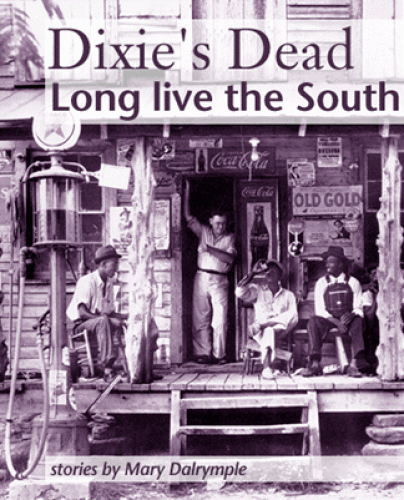
Cotton, Confederates, and chivalry. Self-consciously different from the rest of the Union, the South celebrates its own history, traditions, and culture. But scholars say our Gone With the Wind image of the South obscures the realities - past and present.
Glenn Hinson, associate professor of anthropology, says the South began to see itself as “a place apart” in the early 1800s, when a code of honor and a distinct class consciousness were developing in white society.
“The key image of the old South, of antebellum South, is gentility,” he says. “It’s peopled by Southern gentlemen, demure belles, and happy, loyal servants.” According to Hinson, the romance of the plantation heritage, still celebrated in some corners of white society, is based on historical myth.
“This image is just simply false,” he says. In fact, few plantations dotted the region, and most evolved only after the invention of the cotton gin in 1793. “For the most part,” Hinson says, “the plantation South existed in a tiny window of time of maybe thirty years.”
The Plantation Myth
And the plantation system describes the past of only some Southerners. “While the African-American experience was the plantation experience, the white experience was not,” explains Hinson. “To portray the history of the South as the history of the plantation is to completely forget the existence of the vast majority of white Southerners.”
These forgotten Southerners include hired farm laborers, railroad workers, farmers, grain- and textile-mill workers, artisans, and tradesmen. “Our sense of the grand narrative begins to change when we begin to factor in the experience of working class people and black and white women in the South,” says Jim Leloudis, associate professor of history.
Part of the plantation myth is the image of a South untouched by the industrial revolution. But Peter Coclanis, professor of history and associate dean for general education, argues that the South was integrated into world markets far earlier than the North was. “The South has always been much more affected by global economic issues than many have believed,” he says.
The decline of the rice industry in Georgia and the Carolinas, for example, is usually attributed to the Civil War. But Coclanis argues that the decline was precipitated mostly by changes occurring outside the South, including the rise of steam shipping, the opening of the Suez Canal, and the expansion of commerce in Southeast Asia. “If you look at long-term trends,” Coclanis says, “you can see that these states were already losing their market share long before the Civil War.”
Studying the South in isolation has led scholars to downplay broader historical trends in favor of regional events, and Southern history has become synonymous with the Civil War. “Historians have traditionally locked on to the Civil War,” Coclanis states, “but it’s impossible to understand the South without understanding the world.”
Today, nostalgia for the Southern past is reviving interest in local folk culture. Terry Zug, professor of English and chair of the Curriculum in Folklore, says that many traditions such as hand-made pottery that might have gone out of business 50 years ago due to modernization are now being reclaimed as art.
“Many of the old traditions are absolutely flourishing today,” Zug says. “Such art attracts collectors because it embodies nostalgic fantasies about the past, an imagined time when economic turmoil, ethnic violence, or ecological disaster were supposedly unknown.”
In the plantation myth, Southern society is defined by a clash between blacks and whites. Historians now realize antebellum culture was more complex. “The black and white dichotomy hides historic diversity,” says George Noblit, professor of education. Many Native American tribes populated the Southeast, and there was considerable mixing of the Native American and slave populations. Even within the slave community there was significant diversity. “Many slaves came from the Caribbean,” Noblit says. “There is more diversity in the African-American population than normally admitted.”
As a result, the South is infused with a distinct, historically evolved culture, incorporating more than just black and white heritage. Hinson argues that Southern culture is a creole culture, evolving out of intimate cultural contact and trading. “If you tried to take Southern culture apart and take out the parts that owe their deepest tradition to West Africa, and the parts that owe their deepest traditions to Western Europe, you’d still have a whole lot left.”
This historic diversity still shapes the South, says Daniel Patterson, Kenan professor of English. “To understand the South, you’ve got to come to terms with the diversity of the South,” he says. “All of these pasts leave their residues of attitudes and unresolved problems. They created our world.”
Immigration
Recent immigration patterns are adding new dimensions to Southern diversity. According to Noblit, immigration in the past two decades has come from two sources. First, economic development in the South has attracted highly educated Asian, Muslim, Hindu, and Eastern European immigrants. Second, consistently low unemployment rates have attracted large numbers of Latino immigrants to the South.
“There is a need for workers at the lower end of the industrial scale,” Noblit says. “Some industries even send buses to Mexico.” These immigrants, who once came through the South as migrant workers, now settle permanently. In certain areas - especially rural areas with agricultural industry - the Latino population is beginning to outnumber the black population. Says Noblitt, “Latinos will soon become the largest minority in a number of small towns in North Carolina.”
An Economic Proving Ground
New immigration patterns, economic downsizing and dislocation, and the transition to a service economy are all affecting the South as much as the rest of the country. But Coclanis says some of these changes are familiar.
“The South has already experienced many of the problems and throes of economic adjustment the U.S. as a whole has been going through in the past decade,” he states. “What is happening to manufacturing and services today happened to Southern agriculture one hundred and thirty years ago.”
Coclanis argues that the Southern economy has historically been affected by the migration of capital and labor now seen in many parts of the country. Industry and jobs came to the South, attracted by business incentives and inexpensive labor. And the South has lost jobs to areas of even cheaper labor.
This experience has made the South a testing ground for economic growth policies. “Restrained macro-economic policies and pro-business economic environments were tested policies of Southern governors,” says Coclanis. “Many parts of the U.S. are using the South as a model.”
Economists are not the only ones applying lessons learned in the South. Scholars from many countries are interested in learning how the South has dealt with issues of diversity and multi-culturalism. “It makes sense for other parts of the world facing these questions to look to the South, where you can see the dangers and the real potential for accomplishment,” Coclanis says.
The Pressures to Change
Drastic changes - demographic, social, and economic - present the South with challenges and stress. In eastern North Carolina, for example, large-scale hog and poultry production is changing the nature of agriculture.
Steve Wing, associate professor of epidemiology, has been studying the swine industry’s effect on the environment and health. Wing says that intensified hog production is more akin to manufacturing than to farming. Ownership and decision-making are typically located outside the community. Large operations can dominate the market, forcing smaller farms out of business.
“It’s not only a loss of jobs,” Wing adds. “It’s also a loss of land.” Land that traditionally has been held by local communities, particularly African-American communities, is now owned by businesses outside the area. Wing says land is not only an economic base, but also a source of social stability.
Scholars disagree over how such changes will affect Southern culture. Noblit insists that the South is losing its character. “The South is becoming ‘Yankeeified,’” he says. “The upper classes are no longer Southern. They are more likely to be corporate immigrants.”
But others believe that Southern culture is resilient. Patterson maintains that traditional religion, music, and storytelling are Southern resources for coping with change. “Folk cultures - traditional songs and stories - create unity and teach young people the value of the group and culture,” he says.
Hinson agrees, and insists that modernization does not necessarily mean cultural loss. Citing traditions that are distinctively Southern yet relatively new, such as African-American gospel music and NASCAR, Hinson argues that new traditions are constantly emerging. “The South maintains its ways of keeping its identity. This is not a zero-sum game.”
Rebel Flags and Manly Men
Southerners are no more likely than anyone else to fly the confederate flag, according to the Southern Focus Poll. But they are more likely to think that men are less manly and women less feminine than they used to be - and that this is not good.
Carolina’s Institute for Research in Social Science conducts the poll to find out if Southerners really are all that different from everyone else. The Fall 1996 poll was co-sponsored by the UNC-CH Center for the Study of the American South and the Atlanta Journal-Constitution.