
Alan Feduccia doesn’t believe that birds evolved from dinosaurs, and he’s not shy about saying so. Though some scientists disagree with him, he says he’s not trying to ruffle feathers, he’s just looking for the facts. Here Feduccia discusses some new clues in the mystery of avian evolution.
Alan Feduccia works among relics. There’s a dinosaur tooth in his drawer. A cast of a fossil, the ancient bird Archaeopteryx, rests on his desk.
“What would the world look like without birds?” Feduccia asks. “Would mammals have evolved into the niches currently occupied by birds?” Feduccia, professor of biology, thrives on such questions. “For me,” he says, “discovery is an end in itself.”
What Feduccia has discovered the past couple of years contradicts some long-held ideas about bird evolution. His recent paper in the journal Science shows that the toothy, reptile-like Archaeopteryx wasn’t the ancestor of all birds as most scientists had long believed. Instead, it seems, Archaeopteryx was just one of nature’s many experiments.
In 1996, Feduccia and Lianhai Hou, paleontologist at the Academia Sinica in China, studied two fossils found in rocks of an ancient lake in China. “These fossils tell us that there was a huge evolution of birds going on before Archaeopteryx that we know nothing about,” Feduccia says.
The Chinese fossils are imprints of a primitive bird and a modern-type bird that lived about 135 million years ago, just after Archaeopteryx. The primitive bird, Confuciusornis, was much like Archaeopteryx - it had the same clawed fingers for climbing and was probably cold-blooded. But while Archaeopteryx lived in Germany, Confuciusornis lived across the world in Asia. The modern-type bird, Liaoningornis, had a breastbone similar to modern birds, with massive flight muscles that enabled longer flights.
“Nobody had ever imagined finding a modern-type bird alongside these ancient birds,” Feduccia says. “And not only were birds very widespread by then, but they also occupied a variety of habitats.”
Feduccia has broken more new ground with his “big-bang” theory. He thinks that the ancestors of all today’s birds evolved explosively in only about 5 to 10 million years. In traditional theory, all modern bird orders appeared by 80 to 90 million years ago and “oozed” into the present. That makes no sense, Feduccia says, because the cataclysmic event that killed the dinosaurs would have extinguished most birds too.
Feduccia contends that about 65 million years ago, most birds died with the dinosaurs, except for a group of shorebirds and possibly a few others. Fossils from just before that time show lots of primitive birds, with the shorebirds the only kind of modern birds present. “But shortly after 65 million years ago, all the primitive birds are gone. All you’re finding are these shorebirds. And then by about 53 million years ago, all the modern groups are present,” he says. “So somewhere between 65 and 53 million years ago, all these modern types of birds evolved.”
Shorebirds survived because their food supply did, Feduccia says. They ate dormant seeds and insects, decaying plants, crabs - life that could have survived a blackout caused by a huge meteorite or other disaster. Birds that depended on green plants that needed sunlight would have quickly perished. And the shorebirds were warm-blooded, so they could regulate their body temperature - a useful skill if the earth had suddenly become cold.
“We’re probably lucky to have birds around at all today,” Feduccia says.
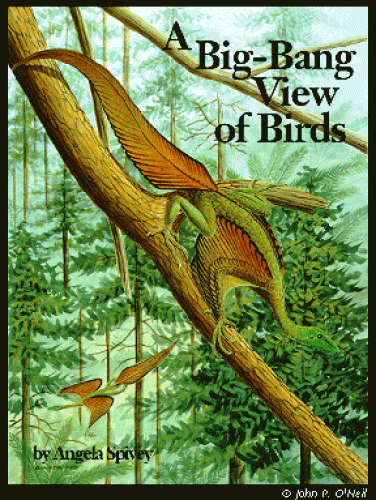
To him, these ideas raise as many questions as they answer. “We’re not really seeing the entire picture,” Feduccia says. He agrees with the theory that the common ancestor of both ancient and modern bird orders was a small, ground-dwelling reptile that took to the trees for hiding, sleeping, or nesting. After this “protoavis” started climbing, it began leaping from tree to tree.
In typical form, Feduccia is thinking about where the next discovery will lie. “Somewhere in fossil beds from about 172 million years ago, at least the middle Jurassic period, an animal like the protoavis awaits unearthing.”
Feduccia is probably best known for challenging the view that birds evolved from dinosaurs. “The more you dig into the facts,” he says, “the more the goblins start to creep out.”
He brings together all the points supporting his position in chapter two of his latest book, The Origin and Evolution of Birds (Yale University Press, 1996). For instance, he says, the dinosaurs thought to be most like birds lived 80 million years after the first-known birds. And when you get down to the details, even these dinosaurs weren’t all that similar to birds. For example, dinosaurs had recurved, serrated teeth, while the early birds had peg-like teeth.
But flying is the biggest problem. A dinosaur, turkey-size or larger, would have had to begin flight by running and then jumping off the ground. Not possible, Feduccia says. Its short front legs would have had to re-elongate to evolve into wings. This almost never happened in evolution.
And sprouting feathers would have slowed down a dinosaur trying to fly, Feduccia says. “Feathers produce turbulence and drag, which is just the opposite of what you would want if you were going to evolve flight from the ground up.”
In 1996, a fossil was discovered that some scientists contend shows a dinosaur covered with down-like feathers. “That’s almost certainly wrong,” Feduccia says.
He pulls out a photograph of the fossil. “What you find is a darkened area from the nape of the neck down to the tip of the tail,” he says. “And it’s almost certainly one of these lizard-like frills running down the back. It has nothing to do with feathers.”
Concluding that this dinosaur had down is “ridiculous,” Feduccia says. “In baby birds with down, when they become wet, they will die of hypothermia unless they get under the mother’s wings immediately. So having down in a terrestrial dinosaur would be maladaptive. They would become mucked up and wet.”
Feduccia says he’s not looking for controversy; he’s just looking for the facts.
“My book is the first major publication to seriously question the dinosaurian origin of birds,” he says. “So I’m getting a lot of heat. But there haven’t been many revolutions without shots fired.”
Alan Feduccia has been appointed as the new chair of the Department of Biology in the College of Arts and Sciences, effective July 1.