
Vampire bats, killer whales, and human beings have something in common other than our occasionally bloodthirsty reputations. All of us share.
Take the vampire bat, for instance. Bats burn energy quickly, so they starve if they have to go two or three days without food. On any particular night they have a good chance of failing to find a meal. Unsuccessful for one or two nights, a hungry vampire bat will stroke the full belly of a well-fed comrade until it regurgitates a share of its meal. So the hungry bat lives to fly another day.
“This goes beyond what you’d normally expect,” says Bruce Winterhalder, professor of anthropology and chair of the Curriculum in Ecology. “You wouldn’t be surprised if a mother would share with her offspring, or maybe close relatives would share, because there’s a genetic or evolutionary interest in that. But what is surprising is that there appear to be sharing friendships that develop in these bats irrespective of their biological relatedness.”
So the impulse toward generosity is neither uniquely human nor a matter of ethics alone, Winterhalder says. “Anthropologists for decades have observed that hunter-gatherers routinely share food. Various models of what it means to be human have been built around the idea that sharing was a matter of generosity central to the ethic of these people — and that’s true. But behavioral ecologists have now developed five or six different explanations for why people would share food. And those explanations have come out of evolutionary theory.”
For people as well as for bats, sharing reduces risk and helps ensure survival of the group. But another motive for sharing has to do with what Winterhalder calls scrounging, or tolerated theft. “If you live in a small group and you happen to be the one sitting there with a big chunk of something to eat, it’s very difficult to say no to someone who comes up and asks for part of it,” he says. “Because it’s probably going to be more trouble for you to deny them a share of that chunk than it is to give up some of it. This can be worked out mathematically, so that you can analyze the costs and benefits, the marginal returns to each party, of this kind of tolerated theft.”
Mathematical models for doing such analysis have become key tools in the young field of human behavioral ecology, which emerged in the mid 1970s as a synthesis of biology and anthropology. As a student at Cornell University, Winterhalder studied with Steven Emlen, whose research on the formation of families in birds reminded him of humans. But while others were mapping these patterns in summary fashion — as trends in populations of, say, people or birds — Winterhalder wanted to understand how the trends arose from the choices of many individuals.
Early in his career, Winterhalder conducted fieldwork with hunter-gatherers — the Cree in northern Canada. Later, he moved into the Andes to study agricultural production — a serendipitous sidetrack.
“Having spent eight or ten years trying to understand the Cree as hunter-gatherers, I wanted to gain similar experience with agriculturalists from the same perspective — how individuals make decisions about subsistence. The idea was that if I could have some experience in both kinds of systems it would help me with what I think is one of the grand problems of anthropology — what evolutionary circumstances brought about the change from hunter-gatherer populations to agricultural populations through the process of domesticating plants. After hundreds if not thousands of papers, we still don’t understand that process well. We know an awful lot about it, but we don’t understand it. So I think of it as one of the great issues of human prehistory.”
Winterhalder says he and his colleagues are just beginning to make some headway on the answers. Dolores Piperno and Deborah Pearsall’s The Origins of Agriculture in the Lowland Neotropics, published in 1998 by Academic Press, adopted a behavioral ecology approach pioneered by Winterhalder and his colleagues, with implications for contemporary issues such as the preservation of seed diversity and natural habitats. The book inspired Winterhalder and Doug Kennett, an archeologist at the University of Oregon, to sign an agreement with Smithsonian Institution Press to produce a volume titled Foraging Theory and the Origins of Agriculture, which will include contributions from archaeologists around the world who are working with similar models.
The models, which are analogous to those economists use to understand the behavior of consumers in a market economy, attempt to account for part of the bewildering diversity of the choices made by individuals who live instead within ecosystems. Within that diversity, Winterhalder and others are finding common motives, common themes. One of them is avoiding risk, which he says is not just a motive of hunter-gatherers sharing food. Even when a population settles into agriculture, risk goes with the territory.
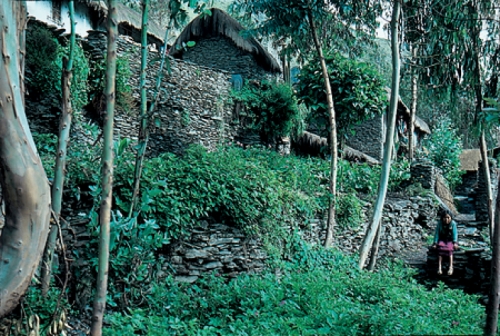
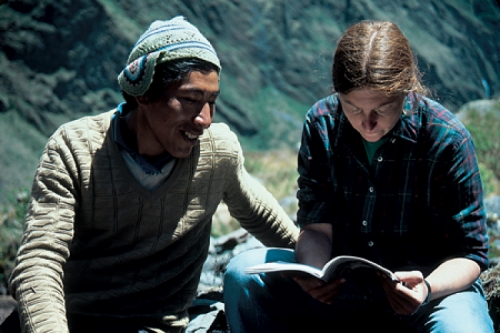
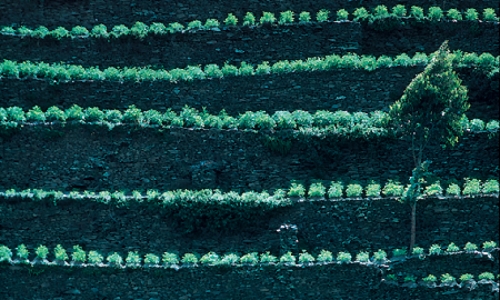
Among farmers in the Andes of Peru, Winterhalder found that a farm family might scatter a dozen or more fields hither and yon over high altitude ridges and valleys. This is not because Andean farmers are inefficient, or because they especially enjoy tramping up and down the mountain slopes. Winterhalder’s team gathered data on over 700 agricultural plots managed over a period of two years by 20 families in the Andes.
Using a computer-based geographic information system, which correlates various layers of information to positions on the landscape, the team plotted the paths between these fields, elevations and distances, and then calculated such things as the time it took to walk, the number of trips to the fields, and the amount of seed and fertilizer the farmers carried.
“When we calculate all of this,” Winterhalder says, “it turns out that the cost to net production of this scattering is about seven percent, which is quite a lot lower than economists had actually estimated.”
Winterhalder then posed the question: “What if this family had grown everything in just one of the spots where one of its fields was located. What would have been their production that year? And what would have been the variability, especially their chance or risk of failing to produce enough?” The variability, he found, was enormous. For each position in the landscape, weather, sunlight, soil conditions, pests, crop diseases, and other factors varied significantly from one year to the next, and the effects could be drastic.
“On any given year, there was a high probability that a family farming at only one or two locations would not produce enough food to meet their needs,” Winterhalder says. “But if you scatter that production over twelve or thirteen fields, the reliability of producing enough to feed your family approaches one hundred percent.”
American farmers typically don’t scatter their fields because the federal government offers crop insurance and other ways to avoid the risk of crop failure. The Incas, with their sophisticated system of central grain storage and distribution, also probably had no need for field scattering, Winterhalder says. But the common-sense idea behind field scattering remains ingrained in our behavior, even today. From childhood, we’re warned not to put all of our eggs in one basket. Gamblers hedge their bets. Investors balance their portfolios.
This kind of decision-making, Winterhalder says, may have originated with bands of hunter-gatherers sharing food whose sources were asynchronous — that is, the sources and the success of individual hunters and gatherers varied from day to day. In fact, the typical hunter-gatherer band of 25 to 45 people, of whom some 6 or 8 would have been productive hunters, was, according to Winterhalder’s mathematical analysis, just large enough to ensure that everyone got fed, even if most of the hunters came up empty some days.
“Even if there’s only a small amount of asynchrony in the sources you’re pooling, you don’t need very many folks to get a pretty large advantage,” Winterhalder says. “Six, seven, or eight hunter-gatherers give you that advantage.”
While Winterhalder’s studies focus primarily on basic understanding, the work has a practical side, as well. For example, learning how people exploit their environment yields information that may be useful to those managing natural resources, he says. His mathematical models include simulations in which foragers make decisions about which prey or plants to harvest based on principles of foraging theory.
“We then use a computer to examine the impact of the decisions on the animal populations, their densities, and their ability to recover their numbers, and how changes in those densities affect the way people make their decisions about foraging,” he says. “The results can yield information about which species are most vulnerable to localized extinction and why.”
He points out that conservation biologists and game managers never have enough empirical data to make sound predictions. “Humans live a long time, and some of these game species live a long time,” Winterhalder says. “The demographics of their interaction with each other play out over dozens of years or longer periods of time. For all of the generous funding of research in this country, nobody gets grants to study the same population for dozens of years in a row. It just doesn’t work that way. So what we’re trying to figure out is how we can help advance the understanding of those processes through behavioral ecology models and computer simulation. For instance, there are proposals from conservation biologists in places like Brazil to set up large reserves in which native people continue to have rights as managers and harvesters of game. Ethically, since these people are indigenous to those lands, that makes some sense. But we need to understand more about the populations and how they are using the game. For example, they have rifles rather than blowguns, now. What’s going to be the impact of a change like that?”
In fact, people in various fields are finding unexpected uses for foraging theory, Winterhalder says. Working at home on his family’s genealogy, Winterhalder typed his name into an online search and turned up a couple of papers by a group of software engineers who were applying his work to help them analyze how people look for information on the World Wide Web.
“If you had asked us ten years ago if someone was going to figure out how to apply foraging theory to internet software engineering, we would have said, ‘Are you kidding?’” Winterhalder says. “But here was a group who had done it.”
On the web or in the wilds, individuals make choices as they forage, and these choices accumulate into trends that can drive a sector of the economy or determine the fate of an ecosystem, Winterhalder says. But for some social scientists, especially those who embrace the principle of human uniqueness, the ideas of human behavioral ecology are troubling. For years, Winterhalder and his colleagues have encountered people who felt that finding evolutionary or ecological explanations for human choices is to take a position in favor of biological determinism, to reduce the sublime complexities of human culture to the basics of biology.
But in Winterhalder’s view, there is nothing antisocial or demeaning in the notion that human beings have always been a part of Nature’s give and take. In a paper about the ecology of hunter-gatherers, he writes: “Behavioral ecologists acknowledge that hunter-gatherer behavior surely is complex and multi-causal in origin, but they also insist that until we know the effects of causes taken separately, there is little possibility of understanding their actions taken together.” He adds, “We happen to be focusing on causes that have their bases in ecology and evolution, in part because they seem to be more predictable from theory.”
So for Winterhalder and his students and colleagues in behavioral ecology, the hunt is on. They are ranging the planet and crunching the numbers, foraging for the evidence that will help us understand how we became who we are. And as they find that evidence, they will know what to do with it. They will bring it back to camp. And then they will share.