
You can remember a phone number long enough to dial the digits. You can remember the words at the beginning of this sentence so that you can make sense of it by the time you reach the period.
Scientists have been interested in this fundamental ability, called working memory, since the early 1900s, when researchers found that monkeys used particular areas of the cortex to perform tasks involving working memory. That and many other studies tell us which part of the brain controls working memory, but there is still the problem of finding a good way to measure it in infants.
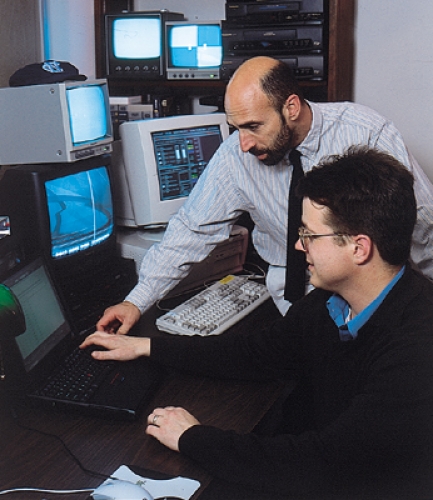
J. Steven Reznick, professor of psychology and director of the Program in Developmental Psychology, graduate student Kevin Pelphrey, and their colleagues set out to figure out when working memory develops. They found themselves living by the motto If at first you don’t succeed, try, try again.
At first, Reznick emulated earlier studies but worked with human infants instead of monkeys. While a baby sat on its mother’s lap, Reznick and his students showed the baby a toy. Then they hid the toy in one of three or four shallow wells on a large table and covered the wells with a cloth. After distracting the baby, the researchers watched to see if the baby reached for the well in which he or she saw the object placed. The researchers varied the length of time that they distracted the baby and the number of different wells from which the baby chose. Over the course of 12 trials, the researchers were able to tell whether the baby was able to perform the task more often than would be expected by chance alone.
But what if the baby just wasn’t interested in the object being used and therefore didn’t bother grabbing it? Researchers tried to factor in that possibility by using something that fascinates all babies—people. They cut two holes into a large table, then had a graduate student stick her head through one hole and talk to the baby, again seated on its mother’s lap. “Hi baby! Hello there!” The graduate student would duck down as the two holes were covered, and the baby was then distracted by a snap of fingers or a clap of hands. Did the babies then grab for the correct hole?
“There was something about reaching out for a disembodied head that babies just didn’t like,” Reznick says. Understandable.
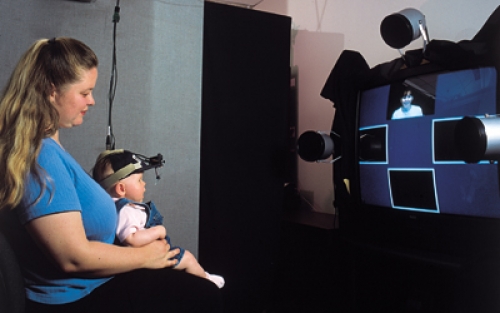
So then what? “We took a big piece of standing Masonite and did the same thing,” Reznick says. A graduate student would look through one of two windows, talk to the baby, and then a curtain would go down. “We would spin the baby in a swivel chair, stop, pull the curtains up, and no one would be in either of the windows,” Reznick says. Where the baby looked would indicate whether working memory kicked in. Wanting to automate the process, Pelphrey used computer software to do something similar on a large monitor—with up to 20 different spaces to choose from rather than only two. Instead of spinning the swivel chair, they broke the baby’s concentration by orienting all of the windows to the center of the screen for a period of time, then returning them to their original location.
With numerous spaces arranged on a monitor, how could researchers know exactly where the baby’s eyes were focusing? Eye movements are very slight, so determining precisely where a person, particularly a baby, is looking is no easy feat. The solution was tiny, ingenious headgear developed by a company called ISCAN. Reznick, Pelphrey, and lab director Barbara Goldman adapted the headgear—a visor with two miniature video cameras. One camera looks forward from the front of the eye to where the child is looking. The other looks down and across a special lens and at the eye, while an infrared light bounces off the back of the eye and backlights the pupil.
“The quality of the lens is such that the child is able to look straight through it—most of the babies don’t even notice the cap once it’s on,” Goldman says.
Reznick explains, “Software calibrates the information from the cameras. Then a crosshair that corresponds to the exact spot where the baby is looking appears on the screen.” As the baby looks at a space on the large monitor, researchers see the precise location on the smaller screen, and the precise coordinates of the baby’s gaze are recorded by the computer. Reznick says that the method has been used in other contexts, including to sharpen aim during military operations and as a communication device for people with special needs.
For his dissertation Pelphrey used both the table-object test as well as the computer-visor test with children aged 6, 8, 10, and 12 months. The study (conducted in Reznick’s lab at the Frank Porter Graham Child Development Center) showed that at 6 months of age, babies locate the hidden object more than 50 percent of the time—a rate slightly higher than chance. The percentage increased with the age of the baby tested.
“You see a gradual, linear increase in their ability to perform the task, so that by twelve months, the babies are good at both versions of the test,” Pelphrey says. He, Reznick, and their colleagues believe that working memory develops all the way up to puberty. Other researchers have shown that the ability begins to deteriorate with age or with diseases such as dementia.
Reznick hopes these findings will lead to longitudinal studies that look at how and when working memory initially develops—starting even younger than age six months using just the visual procedure. “The only way for a baby to complete the manual task is for him or her to reach—an act that involves telling the hand, ‘Okay, I need you to get out there and grab that cloth,’” Reznick explains. A baby doesn’t become capable of doing that until about age six months.
Reznick is also studying whether individual differences in working memory might be related to developmental disabilities. He’s collaborating with researchers at the Frank Porter Graham Child Development Center to assess working memory in infants who have a type of mental retardation called Fragile X syndrome. And graduate student Andrea LeGore is conducting a study in Reznick’s lab of working-memory development in preterm infants.
What is a baby’s existence like before it develops working memory? “Working memory is such a pervasive part of our mental life that it’s hard to imagine being without it,” Reznick says. But he suggests that it might be like living always in the present, without the ability to think about what will happen next. When the working memory does become available, a fundamental shift in the infant’s mental capabilities likely takes place. “It must be a profound change,” Reznick says.
Understanding the underlying physiology of working memory might provide better insight into how it develops. A piece of the puzzle, definitely, but not the be-all and end-all of the story, Reznick says. “Perhaps more important than how it’s happening is how it affects the baby’s life.” Chances are working memory is vitally important for the skills that come later such as learning and understanding language. That, of course, makes the ability to measure working memory and an understanding of its development all the more important.
“We’ve opened the door into what seems to be a very interesting house,” Reznick says. “We’re shining a flashlight into this first room, looking for a light switch.”
Jill Aitoro was a student who formerly contributed to Endeavors.
Kevin Pelphrey is now a postdoctoral fellow at the N.C. Neurodevelopmental Disabilities Research Center.