
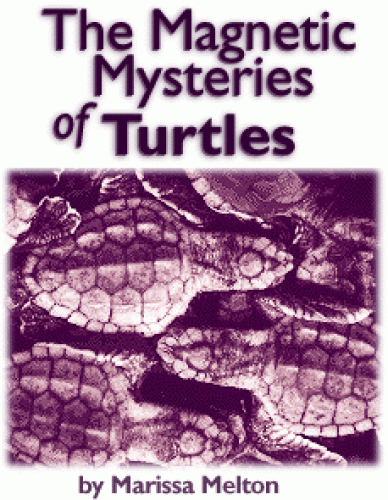
Each year in early July, when loggerhead turtle eggs start hatching on the shores of eastern Florida, Ken and Catherine Lohmann pack a van full of computers, coolers, and lab equipment and rumble down the road to Boca Raton, Florida. They are going there to learn how turtle hatchlings find their way to sea.
The turtles are headed for the North Atlantic gyre, a system of warm-water currents that spans the Atlantic between the eastern coast of North America and the western coast of Africa. The turtles may linger there for years, feeding on seaweed, until they grow large enough to return to American feeding grounds without fear of predators near the shore.
Navigational skills are crucial. A turtle straying off course at the north end of the gyre could wash up on the shores of Great Britain, shocked with a lethal dose of cold North Atlantic water. A turtle swimming south out of the gyre could be swept up in south Atlantic currents and carried away from its range.
How the turtles find their way back to the nesting ground has long been a mystery. But part of the answer, the Lohmanns believe, lies in the turtles’ ability to orient themselves through the magnetic field of the earth.
In Florida, the Lohmanns and their student assistants work out of a windowless, cinderblock building on the campus of Florida Atlantic University (FAU), the use of it granted by colleague Mike Salmon, a friend and FAU professor. The loggerhead hatching season lasts through September, but the Lohmanns have only six to seven weeks to conduct their research before the UNC-CH fall semester starts. The pace is hectic.
“Every single night’s a research night,” Catherine says. “We don’t take a night off.”
Workdays start around 10 a.m. with data analysis and maintenance chores, but the research begins late, when hatchlings begin moving under the sand. Around 5 p.m., the researchers head out to the beach with their Styrofoa m coolers.
The city of Boca Raton has people patrolling the beach during the late spring, when adult loggerheads come ashore to lay their eggs. The patrols cover each nest with an open cage, which protects the eggs from vehicles or tourists but allows hatchlings to escape as they surface.
Using identification dates found on the cages, the Lohmanns can estimate to within a couple of days when a set of hatchlings might emerge. As many as a hundred new hatchlings scramble around in the nest before digging their way out, creating a depression in the sand. The Lohmanns dig into the depression with their hands, removing about a dozen turtles and placing them one by one into the coolers to protect them from light.
Back in the lab, the Lohmanns outfit one of the hatchlings with a custom-made Lycra “swimsuit” tethered to a movable arm that is attached electronically to a computer. The swimming tank is surrounded by a magnetic coil, which changes the magnetic field features that the turtle experiences. Meanwhile, a researcher sits at a computer monitor in the next room to plot the turtle’s path. The room in which the turtles swim is dark, to eliminate visual cues.
Scientists have known since the late 1960s that baby turtles make their way toward the sea by pointing themselves toward a light source—low, bright moon and starlight reflecting off of the water. What the turtles did after finding the sea, however, had been a mystery until the Lohmanns began their studies.
“At the point we began,” Ken says, “no one knew that turtles could sense the earth’s magnetic field. We just thought it was likely that they could, because they migrate such long distances.” Limited eyesight, too, was a clue that turtles use some other sense to get around. “They have eyes that have evolved to see underwater,” Ken says, “and that means that when they lift their heads above water, they’re extremely nearsighted.”
The Lohmanns found that, once in the water, the turtles oppose the motion of the waves. Swimming straight into a wave means swimming away from shore and the predators that lurk there. Farther offshore, the waves begin moving in directions other than straight away from land. At that point, turtles must use a different method of orientation.
Most recently the Lohmanns have discovered that turtles might even carry magnetic “maps” around in their heads, memorizing the unique magnetic properties of the nesting ground or feeding ground. Each place on earth has unique magnetic properties, identified by two characteristics. The first is called “lines of inclination,” which define the Earth’s magnetic fields and vary with surface features. The second characteristic is the intensity of the magnetic field, which also varies across the earth’s surface. Field intensity is expressed in units of nanoTesla, or nT. In many areas of the ocean, the lines of inclination and intensity form a grid roughly corresponding to lines of latitude and longitude.
The Lohmanns tested the turtle’s response to magnetic fields by placing a hatchling in a tank, applying a magnetic field, and watching which way the turtles swam. When the researchers simulated a field where the intensity is 43,000 nT, a level found off the coast of Portugal, the turtles swam west as if to head for the currents that would carry them back to the eastern shore of America. When the Lohmanns simulated a field of 52,000 nT, approximating the coast off the Carolinas, the turtles swam east.
The Lohmanns have shown that simulating an inclination angle found on the northern edge of the North Atlantic gyre (the presumed migratory route of the youngest turtles) caused the hatchlings to swim south. When the turtles encountered an angle found on the southern boundary, they swam north.
From experiments of this kind, the Lohmanns have concluded that hatchlings may have, at the very least, an ability to use the magnetic field to help them remain within the warm currents of the gyre. There is even some evidence to suggest that hatchlings can pinpoint their locations relying solely on magnetic information.
The Lohmanns suggest that adult loggerheads may possess a more sophisticated mental map. Adult females migrate back to the nesting grounds from which they were hatched when they are ready to lay their eggs, which, Ken says, might be anywhere from ten to thirty years after their own birth. The turtles’ ability to pinpoint a small location and return after so much time suggests that their magnetic sense is more highly developed than the baby turtles’, perhaps from years of experience traveling through the ocean’s currents and different magnetic conditions.
Perhaps the most difficult part of the Lohmanns’ job is the trip out to get turtles from the nests. Tourists and townspeople alike often wonder why the scientists are raiding the turtle nests down at the beach.
“We don’t ever send just one person out to the beach to collect turtles,” Catherine says, “because there’s got to be somebody to talk to the public while the other person is collecting.”
Even with seven-day work weeks, there’s hardly enough time for the writing, experimentation, and explanation that every day entails.
“We stay through the last possible moment,” Catherine says.
And then, a few weeks after they arrive, they pack up the van to migrate again—this time north, home. And by the time they’re back in the classroom, their subjects are swimming steadily toward the refuge of seaweed mats floating over the sea.
Marissa Melton was formerly a staff writer for Endeavors.