
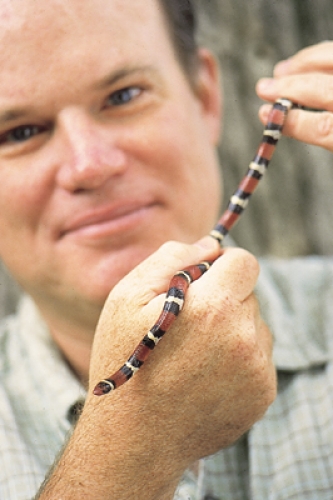
First things first: David Pfennig likes snakes. Grew up hunting them in South Texas, in fact. “The big thing to catch there was the Mexican milk snake,” Pfennig says. “One night my cousin John grabbed one off the side of the road.”
Or so John thought. He’d actually picked up a deadly coral snake.
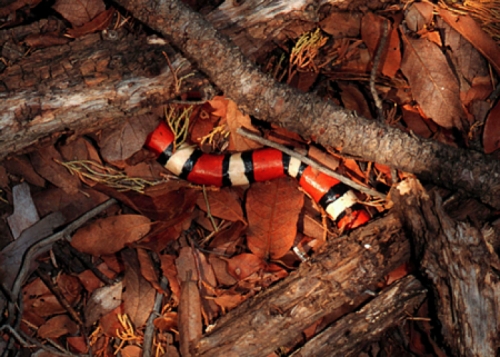
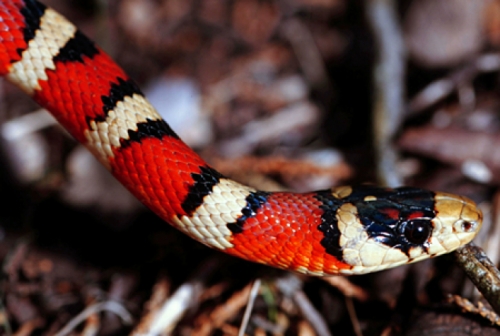
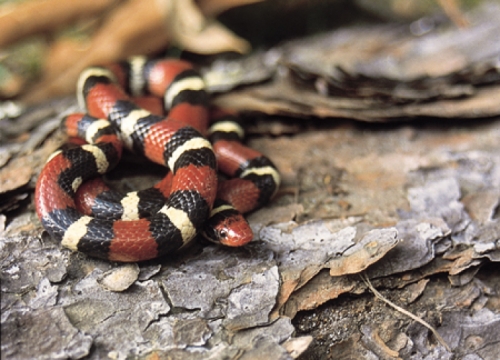
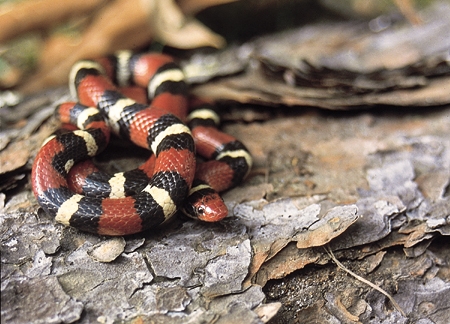
Apart from his beautiful colors—alternating rings of black, bright yellow, and deep red, which are a heads-up DANGER! warning for predators—the eastern coral snake looks perfectly unremarkable. His rounded head is hard to distinguish from his body, which is the same slender diameter all the way down to his tail. His eye is round and dark. He looks like a snake that a kid would make from Play-Doh.
But the coral snake doesn’t play. He’s an elapid, in the same family as cobras and mambas. His venom is neurotoxic, meaning it attacks his prey’s central nervous system, eventually paralyzing the diaphragm. But he tends to be nocturnal, secretive, and nonaggressive, so fatal bites to humans are rare.
Now, Pfennig and his cousin John knew a thing or two about snakes, so John dropped that coral snake in a hurry. But why did he mistake it for a harmless milk snake?
Well, the milk snake is a con artist. It looks a lot like the dangerous coral snake, a ruse that gets it a bit of respect from predators. In North Carolina, we have a similar set of sneaky serpents: the decidedly innocuous scarlet kingsnake bears a striking resemblance to the venomous eastern coral snake. In fact, the two are so similar that we have a little ditty to help us tell them apart:
Red touching yellow, kill a fellow
red touching black, venom lack.
These snakes are prime examples of Batesian mimicry. In 1862, British naturalist Henry Bates proposed that some unprotected species closely resemble unpalatable or harmful species and are therefore avoided by predators. Biologists widely accept Bates’ theory and even use it to illustrate natural selection, Charles Darwin’s mechanism of evolution. But Bates’ idea has never been experimentally proven.
Which brings us back to Pfennig, now an associate professor of biology. He’d been thinking for a couple years about Batesian mimicry. Along came William Harcombe, a Carolina biology undergraduate, who told Pfennig he wanted to get involved in a research project. And Karin Pfennig, who is married to David, is a bioinformatics postdoc at the University of Texas-Austin. The three put their heads together and devised an experiment to test Bates’ idea.
Their plan: find out how scarlet kingsnakes fare when they live far from where any coral snakes are found. Batesian mimicry predicts that these particular kingsnakes shouldn’t be able to rely on their looks for protection from predators.
Why? Because in Batesian mimicry, the predators call the shots. Let’s say there’s a hungry possum near Pinehurst, North Carolina, where both scarlet kings and coral snakes are found. Batesian mimicry holds that generations of evolutionary selection to avoid the poisonous coral snake—and anything that resembles it—have gone into the making of this possum. So the Pinehurst possum sees the scarlet kingsnake as a potential threat.
But does that hold true in Rocky Mount, North Carolina, where no coral snakes live? Batesian mimicry says no: Rocky Mount predators wouldn’t have been under selection to avoid coral snakes. So to a Rocky Mount possum, a kingsnake is probably just dinner.
The team’s idea: plant fake snakes at dozens of sites around North and South Carolina, some in areas where both corals and scarlet kings live, and others far outside the coral snake’s range. The sites would be in game lands and federal wildlife refuges, in hopes that the fake snakes would be molested by real predators, not by say, house cats or people. And the sites should have sufficiently snakey spots—the right kind of rotting log, for instance—”to make sure,” Pfennig says, “that this was a site where a predator would actually find a snake.”
Each site would get three “snakes.” First, a replica of the scarlet kingsnake—a mimic of the mimic. Then two replicas would serve as experimental controls: one, a generic snake, was plain brown. The second control used the coral and kingsnake’s colors arranged in lengthwise stripes instead of rings. “If we used only ringed and plain brown replicas, we wouldn’t know whether predators simply have a generalizable avoidance of bright colors,” Pfennig explains. “So we wanted to make striped replicas, in the same colors as the ringed, just to make sure that wasn’t happening.”
After a month, the team would collect the replicas and determine whether any predators had messed with them. If attack rates on the kingsnake replicas proved significantly higher outside the coral snake’s range, then Bates might have been on to something.
Sounds easy, right? Just tell that to Will Harcombe. He had to make 1,600 snakes.
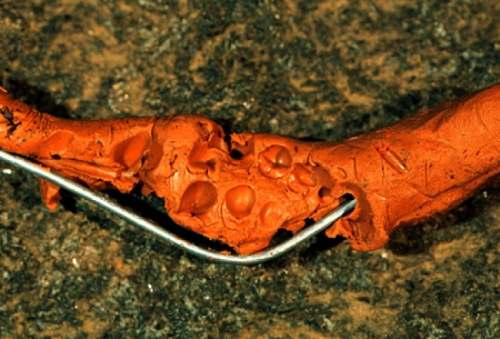
Harcombe made them by molding plasticine—a nontoxic modeling clay that would retain bite and scratch marks—onto lengths of heavy wire. He rigged up a caulking gun and the clay snakes just squirted out. Okay, so it wasn’t quite that easy. But the snakes got made.
And the snakes got attacked. “Some were just mangled,” Pfennig says, pulling what used to be a brown control snake replica out of a numbered paper bag. The replica has been squished beyond recognition, and there are some very large teeth marks in one end of it. “The only animal that could do that would be a black bear,” Pfennig says, “or a wolf. But we don’t have wolves where we’re doing this. So that’s probably a black bear.”
The team gave predators the same options at each site. They tied one of each replica—ringed, striped, and plain brown—to a nail. The nail went into something solid, such as a log, so predators wouldn’t make off with the replicas.
The team expanded their operation to Arizona, where the Sonoran mountain kingsnake mimics the western coral snake. And Harcombe made a whole new batch of snakes—this time with some friends he enlisted as last-minute help.
After Pfennig and Harcombe collected the replicas and brought them back to Chapel Hill, the attacks were “scored” by Karin Pfennig, who had no knowledge of where each replica had been placed. “That way we wouldn’t bias our results with any preconceived notions of what we expected to get,” David Pfennig says.
The idea was to look at the total number of attacks, then determine what proportion of those was on the kingsnake replicas. “If this is truly mimicry, the proportion of attacks on our kingsnake replicas should be lower in areas where there are coral snakes than in areas where there are no coral snakes,” Pfennig says.
But before they dived into the numbers, the team developed a null hypothesis, a kind of simplest plausible explanation. In this case, it meant defining what the results would look like if attacks were totally random. “If predators were just attacking these things willy-nilly, at random, and were not paying any attention to pattern, then we would expect that one third of the total number of attacks would have been on the ringed kingsnake replicas,” Pfennig says. “So values above that one third indicate that predators are actually preferring to attack the ringed replicas. Values below that one third are indicating that predators are avoiding the ringed ones.”
And how did the values add up?
In areas where coral snakes live, fewer than one third of the kingsnakes were attacked. A lot fewer, in fact—only about 13 percent of the total attacks in Arizona were on kingsnakes.
But outside the coral snake’s range, “the kingsnakes got nailed by predators,” as Harcombe puts it. In Arizona, the proportion of kingsnakes attacked was about 50 percent; in North Carolina, the proportion was 65 percent—much higher figures than the team would expect to see if predators were simply attacking the models randomly.
In Arizona predators behaved differently across a remarkably local scale. The western coral snake doesn’t live in the higher elevations of Southeast Arizona’s Chiricahua Mountains. But the Sonoran kingsnake, which mimics the western coral snake, lives in the Chiricahuas’ higher and lower elevations. So the team sampled sites going up the mountain. “These sites are no farther apart than about three miles,” Pfennig says. “And yet we’re seeing significant differences in predator behavior, and it’s even more fine grained than what we were seeing in the Carolinas.”
Other researchers have shown that, from birth, predators avoid coral snake patterns without prior exposure to the snakes. “People have often pointed out that it isn’t effective to have to learn this avoidance behavior,” Pfennig says, “because if a predator makes a mistake, it’s dead. There’s no trial and error. So there’s some evidence that this is probably genetically encoded. What’s remarkable to me is that predators born just maybe eighty kilometers south of us may be born with different genes than predators born here.”
And that keeps mimicry interesting. Consider the different and seemingly incompatible needs of the coral snake, the scarlet kingsnake, and their predators. The kingsnake needs to resemble the coral snake for protection. But the coral snake needs his color scheme to remain an effective warning—which is tricky if a bunch of harmless snakes look just like him. “I’m anthropomorphizing here,” Pfennig says, “but if predators start to learn ‘Hey, most of these ringed things aren’t venomous—I ate one, and I didn’t die,’ then they might attack both kingsnakes and coral snakes.”
The predator simply needs to know whether he’s looking at lunch or the last snake he’ll ever see. “Predators will be under selection to develop greater eyesight, greater cognitive abilities, or whatever it takes to tell the difference,” Pfennig says.
And since the predator exerts all the selection on the system, mimicry is effective even if the coral snake and the scarlet kingsnake never actually encounter each other. That’s why biologists were excited by Bates’ idea in 1862 and remain so today.
“Mimicry adds an interesting dimension to evolution because an individual’s predators, prey, parasites, and hosts can evolve alongside the individual,” Pfennig says. “So it becomes a three-way game in which each player must constantly out-evolve the others. These survival strategies create the ever-improving traits that we see throughout nature.”
David Pfenning was a winner of the 2000 Hettleman Prize for Artistic and Scholarly Achievement.